John Arbuthnot Quotes
King is a title which translated into several languages, signifies a magistrate with as many different degrees of power as there are kingdoms in the world, and he can have no power but what is given him by law; yea, even the supreme or legislative power is bound by the rules of equity, to govern by laws enacted, and published in due form; for what is not legal is arbitrary.
Arbuthnot, John. The Freeholder's Political Catechism. J. Roberts, 1733.

The early human idea that human rulers must somehow divine and/or designated and supported by the deity was present over many cultures and geographies.


The King’s statement was actually given by his chief aide, the Earl of Stafford.


Prior to Cooke’s indictment of English King Charles I, there was a concept of Royal Impunity—that a sovereign could not legally be called to account for his actions as ruler of the state. The concept of “sovereign immunity” was a concept where the sovereign and his agents could be given immunity for specific actions, but they never would have impunity again where there were no limits to the crimes they might commit against their own people. Charles I refused to even recognize Cooke’s indictment and so have heads of state called to account for their major crimes since then all the way down to Saddam Hussein in 2006 who made the same argument. Cooke was himself hanged, drawn and quartered almost 20 years after the Charles I trial for his part in the “Regicide” so the concept of Royal Impunity did not die quickly.


The Queen died later that year.

Some of the Patriots of Early America realized that the oppressions of British rule were coming from Parliament and initially took the position that only the King could make laws for the colonies and not Parliament. Therefore, they were as Englishmen challenging illegal English laws. Most American hostility was directed at Parliament and not the King. However, once there was any physical resistance, King George came down with such a heavy hand that American hatred transferred to him. For related quotes on the King/Parliament issue, see {639145}, {639144}, {639142}, {639141}, {639140}, & {639137}

The assumption of one supreme authority being necessary for a state, has been the most common assumption in almost all cultures and times before the American Revolution. What is amazing is that the Founding Fathers rejected this notion in favor of our complex system of checks and balances restrained by a Constitution which no society had ever tried before. England in contrast as it became more democratic, simply shifted the supreme, uncontrollable entity from the King to the Parliament which it is even today. Parliament can do virtually anything unrestrained by anything except their judgment and tradition.


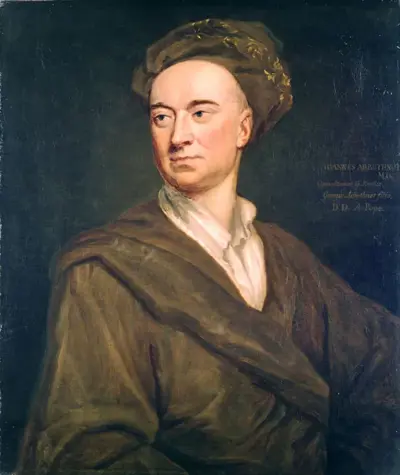
John Arbuthnot FRS, often known simply as Dr Arbuthnot, was a Scottish physician, satirist and polymath in London. He is best remembered for his contributions to mathematics, his membership in the Scriblerus Club (where he inspired both Jonathan Swift's Gulliver's Travels book III and Alexander Pope's Peri Bathous, Or the Art of Sinking in Poetry, Memoirs of Martin Scriblerus, and possibly The Dunciad), and for inventing the figure of John Bull.
