Ryan Zinke Quotes
I've been to war, and I know the consequences and sacrifice it takes. If we must fight, we fight to win.
Zinke, Ryan. Campaign Statement. Ryan Zinke for Congress, 2014.


Reports were widespread that General Grant was an alcoholic and was frequently drunk in the field. Lincoln was under pressure to relieve Grant of his command in the West. To a Pennsylvania politician he explained:


The general was expressing a principle that is believed to this day by many policy makers, military people and civilians: Once a war has begun, one must not stop it until victory has been attained. It is unacceptable to negotiate an end to hostilities unless the enemy has been badly beaten on the battlefield. There is this view that “honor” would be lost and that enemies and even allies will not respect you and think the nation is weak and fearful. So there would always be extensive pressure to keep on fighting and not negotiate until there is a military dominant position.

Trumbo was morally opposed to war. He also refused to name Hollywood communists to Congressional Committees during the Red Scare. He was then blacklisted from his occupation, screen writing.

He was leading the Gordon Highlanders of the British Army against the Boers during the Boer War. He was seriously wounded and could not go on himself with a charge he had ordered, However, waifing his sword he made this famous qutation. Particualrly noteorthy is the derrogatory terms which he used to describe the enemy--the Boers of South Africa. In many wars and cultures, one or more of the combatants, in order to overcome the avarage soldier's reluctance to kill an enemy, characterizes them as less than human. In this case, vermin, who were to be exterminated. There were two predominant groups of whites who came to South Africa, the English who were generally well-educated and were interested in trading with the exhisting inhabitants and investing in businesses using mostly native labot and the Boers. The latter were of Dutch and German origin, poor farmers with little or no land in the home country and little education. Their interest was to create a nation where they could own land to farm. And the lest expensive way for them to increase their farmland was to sieze it from the native Blacks and who were the major forces behind the racial discrimination which became apartheid. The British contolled the government and sought stability and as in most of the British Empire, they wanted English law to prevail including the rights of the Black natives. The Boers had left Europe for good and would thrive or not in Southern Africa. Proportiopnately, the English might have a career in South Africa or serve there for a few years. They were Englishmen in a foreign country. The Boers saw themselves as citizens of Southern Africa who were fighting the native Blacks for control of the land. The English legal system would not allow any of the land seizures and political discrimination that the Boers saw as existential for their survival in Africa. Soon, the Boers took more and more of the law into their own hands and saw English rule and dmination as inimical to their interests in Africa and they tried to create their own independent states in Southern Africa. That was the essense of the Boer Wars. Dick-Cunyngham was awarded the Victoria Cross, the highest military decoration of Great Britain, for his exploits in the Afghan War.


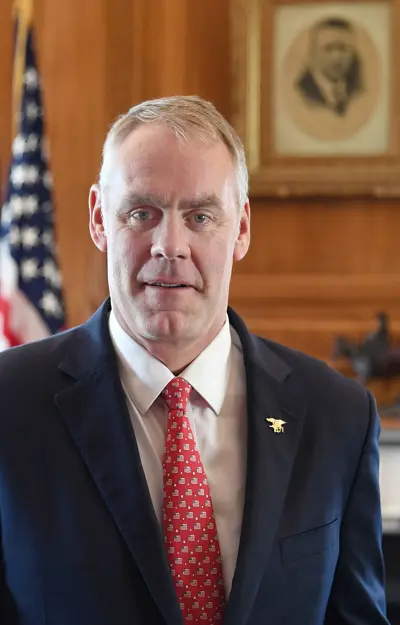
Ryan Keith Zinke is an American politician and businessman who served as United States Secretary of the Interior in the Trump Administration from 2017 until his resignation in 2019. He previously served as the U.S. Representative for Montana's at-large congressional district from 2015 to 2017. From 2009 to 2013, he served as a member of the Montana Senate, representing the 2nd district.
