Craig Crawford Quotes
It’s hard to sometimes get information out of the government. It’s really hard. You can’t do it without asking tough questions.
Craig Crawford, Author and Political Columnist, Speech, Taylor Books, December 16, 2006
Sourced by: Eigen's Political and Historical Quotations


The main reason that the English or American Freedom of Information Act is not used so much by individuals is that the executive agencies make the process of obtaining documents very difficult and then when the government stonewalls, the requestor has to spend a great deal of time and often engage an attorney. The result is that few individuals can spend the time or money and the field consists mostly of media and non profit organizations which have staff and resources.


At the time there was no Secrecy & Classification System nor any laws enforcing secrecy or confidentiality. However there was no freedom of information laws of expectations even on the part of journalists. This was the first Freedom of Information policy of the American government. Some politicians were more open than others but there was no national, governmental before this. There were however leakers and whistleblowers though the terms were not in use. Note that Roosevelt herein created the first whistle blower protection—himself.

Senator Dianne Feinstein, Chairman of the Senate Intelligence Committee, had released an unclassified Summary of the Committee Report on the CIA using torture and perverse treatment of suspect terrorists in the aftermath of the 9-11 attack on New York. Most Republicans argued vehemently that the Report should be classified and kept secret as the CIA behavior was so egregious, unpalatable, and morally reprehensible that there would be negative consequences including perhaps demonstrations and attacks against Americans in foreign countries. Moreover, Terrorist organizations would use the heinous CIA behavior as a recruiting tool for anti-American terrorists. McCain, who had himself been the victim of North Vietnamese torture cited the moral and ethical reasons to prohibit torture but also explained what has been proven over and over again that torture victims will tell the torturer any nonsense that they think the torturer might believe just to get obtain relief from the agony of the torture.

The executive order to which this statement referred was the then new President’s first—Executive Order 13489. It was enthusiastically received by the public, historians, researchers and the media. However at the end of Obama’s two administrations, the system was a little better than when George W. Bush, blocked much of the Freedom of Information Act from being implemented. However, the agencies who want to operate in secrecy without having to deal with public criticism, had developed even more sophisticated techniques of avoiding transparency and when they must disclose, they have developed techniques to delay the process, sometimes even for years, while they study whether the material should be disclosed. The president personally declassified a few CIA files from decades ago that the agency maintained should be secret, but he did nothing else systemic so solve the problem of declassifying and material and nothing to control the over classification which virtually everyone agrees is a major problem. More material is being classified than ever.


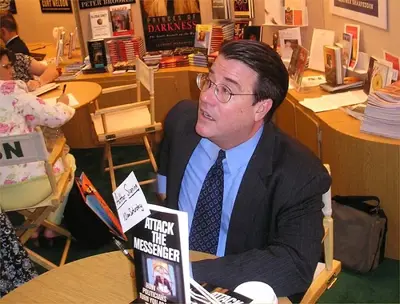
Craig Crawford (born 1956) is an American writer and television political commentator based in Washington, D.C. Publisher of the news commenting forum, Trail Mix, Crawford was a columnist for Congressional Quarterly, Editor-in-Chief of National Journal's The Hotline, and Washington Bureau Chief for The Orlando Sentinel, and the author of Listen Up Mr. President: Everything You Always Wanted Your President to Know and Do, The Politics of Life: 25 Rules for Survival in a Brutal and Manipulative World, and Attack the Messenger: How Politicians Turn You Against the Media.
