Mao Zedong Quotes
It will take a long period to decide the issue in the ideological struggle between socialism and capitalism in our country. The reason is that the influence of the bourgeoisie and of the intellectuals who come from the old society will remain in our country for a long time to come, and so will their class ideology. If this is not sufficiently understood, or is not understood at all, the gravest mistakes will be made and the necessity of waging the struggle in the ideological field will be ignored.
Mao, Zedong. "On the Correct Handling of Contradictions Among the People." Selected Works of Mao Tse-Tung, vol. 5, Foreign Languages Press, 1977, p. 409.

Vladimir Lenin

The British suspected that the Turks of Anatolia were complicit with Bolshevism


The letter was widely published. There were few left wing intellectuals who would take Lenin on at the time but Gorter was one. The immediate quotation shredded a brochure that Lenin had produced for world wide communism where he was critical of other left wing movements.

This is an example of what made the Cold War so difficult. The Italian Communists had great misgivings about the Russian version of Communism that tended to abuse human rights and try and control other countries. However, when the Russian Communists were under world attacks by the West, as with their incursion into Hungary, he urged that all the Communists stick together and defend the Russians even for policies that they thought wrong. On the West side, the same thing occurred. The United States tolerated and supported a number of terribly oppressive dictatorships that were virulently anti-Communist. Polarization was the international norm.
Immediately after the Russian Revolution, the provisional government appointed him as Ambassador to the United States. However, the provisional government was supplanted when the Bolsheviks took over. Not enamored of Communism, he stayed in the United States with many other Russian refugees.


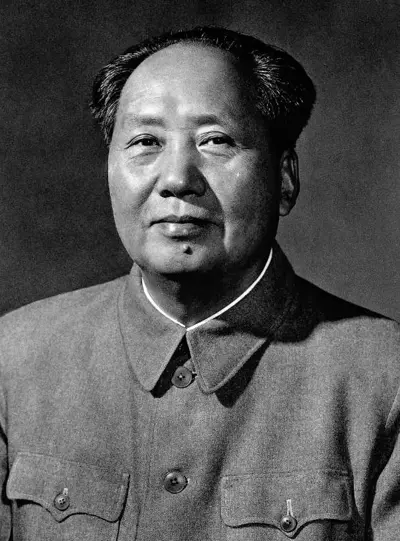
Mao Zedong, also known as Chairman Mao, was a Chinese communist revolutionary who was the founder of the People's Republic of China (PRC), which he ruled as the chairman of the Chinese Communist Party from its establishment in 1949 until his death in 1976. Ideologically a Marxist–Leninist, his theories, military strategies, and political policies are collectively known as Maoism.
