Sam Brownback Quotes
It may seem ironic that the judicial branch preserves its legitimacy through refraining from action on political questions. That concept was put forward best by Justice [Felix] Frankfurter, appointed by President Franklin Delano Roosevelt.
United States, Congress, Senate, Committee on the Judiciary. Confirmation Hearing on the Nomination of Samuel A. Alito, Jr. to be an Associate Justice of the Supreme Court of the United States. Government Printing Office, 2006.


He served on a Supreme Court that was as close to political as any had ever been. Hence his great concern.

This concept of balance of power and the equal role of the judiciary is actually quite rare. Even in Parliamentary democracies the parliament can override any court interpretation. In England, the upper legislative house, the House of Lords, actually serves as the nation’s highest or supreme court. And these “Law Lords” can override all regular judicial bodies.

The New Deal liberal Democrats had complained that the Supreme Court was making national policy and law and not interpreting law. They tried to pack the Supreme Court by adding more justices who would be more sympathetic to the New Deal. (See {587549}.) At the beginning of the 21st century it was the conservative Republicans who were making the same claim that the Supreme Court was making law and not interpreting it. The pattern seems to be when the court votes for your side, they are interpreting the law. When they vote for the other side, they are activist—making law improperly.


In 2002 the corrupt Indonesian Courts ruled that a very solvent Canadian company Manulife was bankrupt so that others could get control. The international financial and political community wanted the Indonesian government to intervene and reverse the rulings, but historically the courts had no independence and had been tools of the government.


The Roosevelt administration had stemmed the tide of Hoover’s Great Depression but the nation had not yet recovered. The New Deal measures, most of which would be considered fundamental to good government 50 years later was being constantly thwarted by a Supreme Court with a strong arch conservative majority headed by James McReynolds, a virulent, overt, anti-Semitic racist, who hated FDR—see {616652} and {585241}. The situation was to many like that which existed before the Civil War when the Court rendered the Dred Scott decision that so harmed the nation. Frankfurter, not then a Supreme Court Justice, urged Roosevelt to do something lest the American Public lose all respect for the Court and our Constitutional system and have the nation harmed by not allowing reforms like child labor laws to go through. The court actually ruled by a narrow majority that the government could not pass laws making it illegal for 11 year old children to work in coal mines or factories. FDR attempted to add more justices turning the majority into a majority—“packing the Supreme Court”, but that politically backfired. Some of the reforms never went through while others needed Constitutional Amendments like the end to Prohibition.


Hatch was the chairman of the Senate Judiciary Committee at the time.
Judicial Review is the principle which allows a court—judges—to declare an act of the legislature or the executive improper and unlawful. It is a standard principle of American government yet it was not explicitly stated in the Constitution. Hence to some, there is a question about the legitimacy of Judicial Review itself. Many nations do not have it. Many people think it is the most important aspect of a democratic society as it provides a check on both the executive and the legislature.


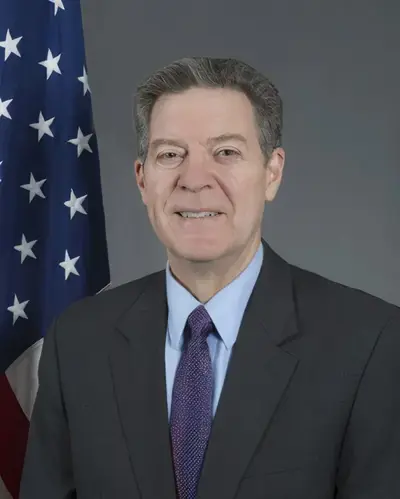
Samuel Dale Brownback is an American attorney, politician, diplomat and member of the Republican Party who served as the United States Ambassador at Large for International Religious Freedom from 2018 to 2021. Brownback previously served as the Secretary of Agriculture of Kansas (1986–93), as the U.S. Representative for Kansas's 2nd congressional district (1995–96), as a United States Senator from Kansas (1996–2011) and the 46th Governor of Kansas (2011–18). He also ran for the Republican nomination for President in 2008.
