Ernest Hemingway Quotes
It is very dangerous to write the truth in war, and the truth is very dangerous to come by.
Ernest Hemingway, 1898-1961, Writer, Quoted in Jessica Kerwin Jenkins, “For Whom the Bell Tolled”, New York Times Book Review
Sourced by: Eigen's Political and Historical Quotations


Theodore Roosevelt was the Presidential nominee. See {634097} and {585962}--Samuel Johnson, for a 1758 version of this idea.


The quotation was given by Defense Secretary Donald Rumsfeld just prior to the war with Iraq, 2003.

Wikileaks had just released 400,000 classified American documents relating to the Iraq War. Many accused him and Wikileaks of endangering the lives of not only soldiers, but Iraq civilians who might be identified as cooperating with the coalition forces by the released documents. The heart of the problem is that governments tend to use classification to hide embarrassing facts or policies that might be controversial as well as to protect legitimate national security secrets and sources and methods of information. The majority of the 400,000 leaked documents, when examined, were clearly not protecting any legitimate people or secrets but just staved off criticism or embarrassment; in many cases, there was no value to the contents and the maw of the censorship and classification process was applied indiscriminately to many documents. A much better argument than Assange made, can be gleaned from the vast number of WWII documents that America, England, France, Russia and others still keep secret, when the people who might have been protected have already died and the methods are long since obsolete.


The French manipulated the war news more than the other nations but nations all did to some extent tending to exaggerate the positive and minimize the negative.


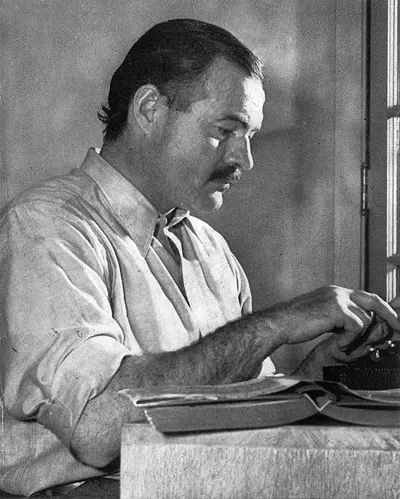
Ernest Miller Hemingway was an American novelist, short-story writer, journalist, and sportsman. His economical and understated style—which he termed the iceberg theory—had a strong influence on 20th-century fiction, while his adventurous lifestyle and his public image brought him admiration from later generations. Hemingway produced most of his work between the mid-1920s and the mid-1950s, and he was awarded the Nobel Prize in Literature in 1954. He published seven novels, six short-story collections, and two nonfiction works. Three of his novels, four short-story collections, and three nonfiction works were published posthumously. Many of his works are considered classics of American literature.
