Sandra Day O'Connor Quotes
It is true that many Americans find the Commandments in accord with their personal beliefs. But we do not count heads before enforcing the First Amendment.
O'Connor, Sandra Day. Concurring opinion. McCreary County v. American Civil Liberties Union of Ky., 545 U.S. 844, Supreme Court of the United States, 27 June 2005, p. 884.


While this principle is very clear to us today, and was to the people who originally ratified The Constitution, there were many attempts by Christian groups to establish a privileged position for Christianity. For example, for years the Sunday Sabbath was legally enforced by unconstitutional Blue Laws that prohibited businesses from operating on the Christian Sabbath and prohibited activities that compete with Sunday church attendance. Supreme Court Justice Story even argued that the First Amendment allowed Christian religious supremacy and Cooley wrote this to refute Story’s now discredited doctrine.

This is a critical quotation on the government establishment of religion issue. There are a few people who have argued over the years that the Founding Fathers and their culture was religious and where they were careful to avoid favoring one religion over another, they did NOT intend to put atheism on the same equal plane as religion as far as government action is concerned. However, some of the Founding Fathers were atheists, and some others like John Adams were deists—they believed in a God but not in the Trinity or in Judaism or any organized religion. So this quotation makes it clear that the First Amendment does NOT favor religion over non religion or secularism. Atheism must be on an equal footing but not on a higher plane.


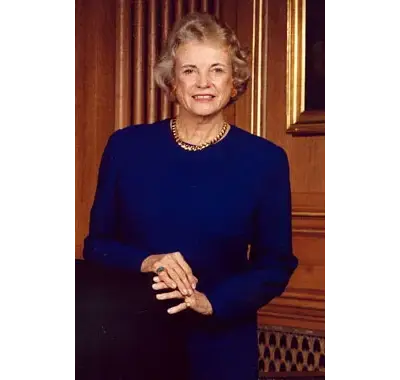
Sandra Day O'Connor is a retired attorney and politician who served as the first woman associate justice of the Supreme Court of the United States from 1981 to 2006. She was the first woman nominated and confirmed. Nominated by President Ronald Reagan, she was considered the swing vote for the Rehnquist Court and the beginning of the Roberts Court.
