Moshe Halbertal Quotes
It is the definition of tragedy. You have all those really good arguments for maintaining a status quo that will destroy you…. We are setting ourselves on fire with the best of arguments.
He argued that every day the area that Israel controlled was becoming more Muslim and less Jewish as a result of differential fertility rates. He argued that unless a separate Palestinian state was created, Israel would either lose its Jewish state identity or maintain it be ceasing to become a democratic state.
Moshe Halbertal, Israeli Philosopher, Comment on the Israeli Policy Towards the Peace Process at the Time, Quoted in New York Times, October 26, 2014
Sourced by: Eigen's Political and Historical Quotations

At the time YaAlon was Rabin’s Chief of Intelligence.


At that time Jews in Palestine were in the minority. The issue of how to obtain the land was hotly debated amongst Jewish groups. Jabotinsky was at one extreme—colonize and take the land just as the Arabs had done to the Jews when there was a Jewish majority. His view did not however prevail. The policy was to buy the land from individual Arabs and Jewish land up to 1948 was obtained that way. In that year the UN partitioned Palestine and 11 Arab armies attacked the new state of Israel and asked the Arab civilians to leave the area so that the Army could cleanse it of Jews. Many did not, and they or their descendants are still on their land or have sold it. The Arabs who left, were suspected of being possible collaborators or terrorists, and they have never been paid for their land or allowed to return. Compensation is still in dispute. At the same time Jews driven out of Arab countries by law and the military have never been compensated or given any right of return either.

Just like Spain and Persia, the Arabs by fighting lost not only more land, but also lost the respect of most of the non-Muslim War. The conscious decision to choose an irrational strategy that would cause loss of life, land and respect has none-the-less repeatedly been chosen by the Arab culture. much to its detriment. Azzam is one of the few Arabs to admit this to the non-Islamic World.


In the complicated and arcane Middle East, substantial majorities of Israelis and Palestinians both favored a two state solution, thus creating a Palestinian State out of the West Bank and Gaza. However, the Hamas terrorist organization won the majority of seats in the Parliament and formed the “government” of the Palestinian Authority. Hamas opposed Israel’s right to exist at all, as that position as well as virulent Anti-Semitic threats to all Jews in the world. Many called for Hamas to change their charter and crease their opposition to the right of Israel to exist. The President of the Palestinian authority called for new elections but Hamas refused. Thus Blair and other diplomats the world over were in a very difficult situation.


The “radicals” refer to the extremely conservative, religiously-oriented Israelis. To them the only real and important element is the land that God gave to the Jewish people. They see the State as artificial and whose only legitimate role is to protect and defend the land of Israel. God has ordained the laws in the Talmud—the first 5 Books of the Old Testament. They do not believe in democracy but seek a Hebrew Theocracy of the Ancient Jews before they made the error of having kings. Some of them opposed the civil government of Israel when the country was founded via a UN resolution and a few would not even defend the new country under a civil government. The relative moderates see Israel as a nation state where the land of Israel can be changed, negotiated, traded as other nations do with their borders. One irony is no one knows exactly the borders of the land which God gave to the Jews and this is why archeology is so politically important in Israel compared to other countries.


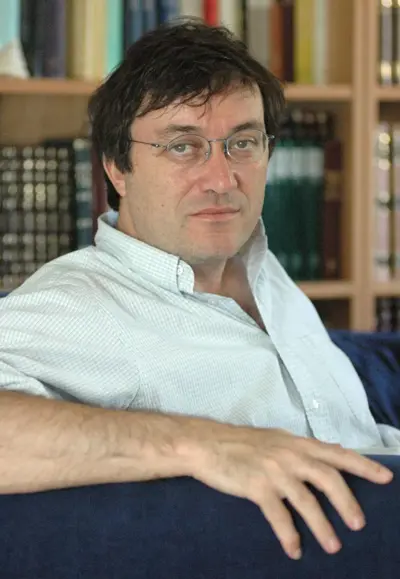
Moshe Halbertal (Hebrew: משה הלברטל; born Montevideo, Uruguay, 1958) is an Israeli philosopher, professor, and writer, a noted expert on Maimonides, and co-author of the Israeli Army Code of Ethics. He currently holds positions as Professor of Jewish Thought and Philosophy at the Hebrew University of Jerusalem and Gruss Professor of Law at NYU School of Law.
