Frederick Barbarossa Quotes
It is not for the people to give laws to the prince, but to obey his mandate.
Bryce, James. The Holy Roman Empire. Macmillan and Co., 1904, p. 169.

William the Conqueror. See Henry of Huntington for another similar description of the King's authority.


This concept was later formalized in British law. See Blackstone.
Sometimes referred to as Gaspar de Toledo. This quotation Illustrates one of the ways that Churches maintained power over the secular government even though they were supposedly separate. By maintaining control over the secular leaders consciences and sense of morality, the Church could control the secular government. In this particular historical case, there was not even a supposed separation. The Confessor had an ex officio role in the high council. See {629457}.

Cromwell was not opposed to monarchy per se as long as it was reasonably checked. He saw Charles II as a terrible monarch. After deposing Charles, he and his associates had to come up with some form of government. As “Lord Protector” he was a de facto monarch without the trappings.

The assumption of one supreme authority being necessary for a state, has been the most common assumption in almost all cultures and times before the American Revolution. What is amazing is that the Founding Fathers rejected this notion in favor of our complex system of checks and balances restrained by a Constitution which no society had ever tried before. England in contrast as it became more democratic, simply shifted the supreme, uncontrollable entity from the King to the Parliament which it is even today. Parliament can do virtually anything unrestrained by anything except their judgment and tradition.


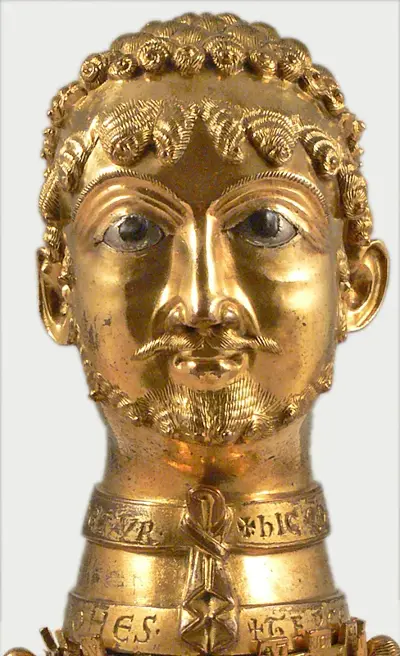
Frederick Barbarossa, also known as Frederick I, was the Holy Roman Emperor from 1155 until his death 35 years later. He was elected King of Germany at Frankfurt on 4 March 1152 and crowned in Aachen on 9 March 1152. He was crowned King of Italy on 24 April 1155 in Pavia and emperor by Pope Adrian IV on 18 June 1155 in Rome. Two years later, the term sacrum ("holy") first appeared in a document in connection with his empire. He was later formally crowned King of Burgundy, at Arles on 30 June 1178. He was named Barbarossa by the northern Italian cities which he attempted to rule: Barbarossa means "red beard" in Italian; in German, he was known as Kaiser Rotbart, which has the same meaning. The prevalence of the Italian nickname, even in later German usage, reflects the centrality of the Italian campaigns to his career.
