Leo XIII Quotes
It is clear that the main tenet of socialism, community of goods, must be utterly rejected, since it only injures those whom it would seem meant to benefit, is directly contrary to the natural rights of mankind, and would introduce confusion and disorder into the commonweal. The first and most fundamental principle, therefore, if one would undertake to alleviate the condition of the masses, must be the inviolability of private property.
Leo XIII, Pope. Rerum Novarum: Encyclical of Pope Leo XIII on Capital and Labor. Vatican Polyglot Press, 15 May 1891, sec. 15.

The Catholic view on the subject varied from time to time, even with the same Pope. See {360616} for another quote from this Pope that gives a different point of view.


Alexander Dubcek, Communist leader of Czechoslovakia, had pushed reform so far that 5 Soviet armies invaded. Dubcek was brought to Russia where he tried to persuade the Russian premier that the invasion was contrary to the principles of socialism.


While generally true, Mises here again exaggerates his “proof” by selectively ignoring or being ignorant of counter-examples. The Roman Catholic Church is a classic counter-example where priests, monks, and others owned nothing as individuals, but produced some great science (eg Gregor Mendel), art (the illuminated texts of the middle ages), literature (St Thomas Aquinas, etc). The best counter example that was just evident in the last decade of Misis’ life is Communist Russia. Russian science was better than Fance and Germany and second only to the United States. The Russian ballet and orchestras were second to none. Great literature came out of the Soviet Union and the best of it complained about and attacked the Soviet system of the times. In general, Mises principle tended to be correct throughout history but not always as he dogmatically stated.


In many countries, the king received all land and most property upon the death of a landowner.


This was written and adopted by Vermont a decade before the United States Constitution the ideas for which were in existence in America before the Constitutional Convention in Philadelphia.

This is a fascinating quotation in that Cooper was a strong patriot of the American system. Today, this statement would be considered un-American and communistic. The notion that each person had a right to a share of land ownership. America changed in this respect. In Cooper’s day, there was so much land and so few people that it was part of the American concept that each man should have land. (Free men and not slaves of course). But as the population grew, speculators realized that there was opportunity and today in America ALL LAND is owned by people, corporations, other organizations and the government. The population is still growing and the potable water is in shorter and shorter supply. Already, we have to pay for water in much of the country. Perhaps in years to come, someone who argues that each person is entitled to clean air to breathe might be thought of as a radical communist.
Most conservatives of today would be surprised that this fundamental notion evolved from the liberals when conservatives were advocating imperial monarchies and powerful states in control of all their resources.

It was drafted by John Adams. 9 Years later the French in their Revolution used the first clause in their Declaration of the Rights of Man and of the Citizen—See Quotation 602404 For an opposite point of view see Quotation 635927.


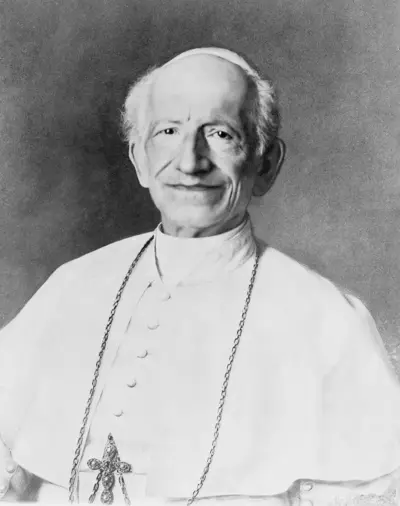
Pope Leo XIII was the head of the Catholic Church from 20 February 1878 to his death in 1903. He was the oldest pope (reigning until the age of 93), with the exception of Pope Benedict XVI as emeritus pope, and had the third-longest confirmed pontificate, behind those of Pius IX (his immediate predecessor) and John Paul II.
