William Sloane Coffin Quotes
It is bad religion to deify doctrines and creeds. While indispensable to religious life, doctrines and creeds are only so as signposts. Love alone is the hitching post. Doctrines, let’s not forget, supported slavery and apartheid; some still strive to keep women in their place and gays and lesbians in limbo. Moreover, doctrines can divide, while compassion can only unite
William Sloane Coffin, 1924-2006, CIA Agent (Early in his career), Presbyterian Clergyman and President, SANE/Freeze, Chaplain, Yale University, Speech, 2002
Sourced by: Eigen's Political and Historical Quotations


This explains why demagogues usually choose scapegoats or politicians often turn subgroups against each other or find a dangerous enemy that all can hate.


Pen name: Jack Nipps

Religious and ethnic political conflict had broken out in Fiji. Some in the Christian majority strove to make Fiji officially a “Christian country” and marginalize the Indian Hindu minority. The archbishop opposed and thwarted them.


Starting with the Crusades, the Popes began giving indulgences to those who would die in battle fighting for a holy cause. The Papacy was then at one of it’s lowest points. Two men, Clement and Urban, both claimed the Papacy and each had raised an army to fight the other. Each was promising indulgences to those who would fight, and in a modality similar to the Muslim terrorists of the 21st century, the soldiers were promised ascendancy to Heaven if the fell in battle for such a holy cause. Wycliffe, in a wonderfully original notion, proposed that the people who live in peace be granted the indulgences. See {618086}.

The Soviet state had varied views regarding religion in different times. In the early days of the Russian Revolution, the Russian Orthodox Church was a major supporter of the Csar and serfdom. That caused a certain hostility to the Russian Church. That Church meanwhile had previously been extremely hostile to Jews and Roman Catholics and never recognized Protestant Churches. So Russians as a group were already discriminating against all religion except the Russian Orthodox Church before the Communist Revolution took place. When the Russian Communists were well entrenched in power, they saw the Russian Church as an obstacle to modernization and were hostile to any group that had a loyalty to any force or deity that was not the Soviet State.


Martin wanted William Howard Taft to answer questions about his religious beliefs. Taft was TR’s selection to be his successor. Ironically, a starting with John F. Kennedy, many presidential candidates have been asked about their religious belief’s and have answered whereas Roosevelt would have them not reply to such inquiries.

These lines illustrate a tactic of many Muslim leaders who go out of their way to make moderate statements to the Western press and media audiences while whipping up extremism when appearing on Middle Eastern media.
Alabama passed a set of laws making it a crime to assist undocumented immigrants in any way. However, many of the religions in Alabama required providing sanctuary. It would not be Christian to provide food for poor documented immigrants and their children but not provide food for poor illegal immigrants and especially their innocent children. Many of the religious groups in Alabama filed a lawsuit to declare the Alabama state laws unconstitutional. The Federal Courts did do but the basis of their ruling was the state was encroaching on a Federal function—control of immigration. The court did not have to rule on the thorny issue of interference with religion so the point has not yet been settled.


Jews were forced to convert to Catholicism under penalty of death. While the archbishop did not approve, he did not describe the murders in moral terms or used his great religious power to stop the practice.

Wesley had been to Island several times and was interested in affairs there. He was a strong advocate of freedom of religion but the violence of the earlier religious conflict made him very wary of the Irish Roman Catholics who seemed to him particularly prone to religious violence.

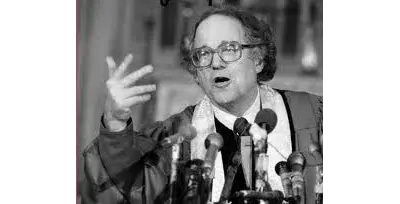
William Sloane Coffin Jr. was an American Christian clergyman and long-time peace activist. He was ordained in the Presbyterian Church, and later received ministerial standing in the United Church of Christ. In his younger days he was an athlete, a talented pianist, a CIA officer, and later chaplain of Yale University, where the influence of H. Richard Niebuhr's social philosophy led him to become a leader in the Civil Rights Movement and peace movements of the 1960s and 1970s. He also was a member of the secret society Skull and Bones. He went on to serve as Senior Minister at the Riverside Church in New York City and President of SANE/Freeze (now Peace Action), the nation's largest peace and social justice group, and prominently opposed United States military interventions in conflicts, from the Vietnam War to the Iraq War. He was also an ardent supporter of gay rights.
