Karl Marx Quotes
...it happens that society is saved as often as the circle of its ruling class is narrowed, as often as a more exclusive interest asserts itself over the general. Every demand for the most simple bourgeois financial reform, for the most ordinary liberalism, for the most commonplace republicanism, for the flattest democracy is forthwith punished as an assault upon society and is branded as Socialism.
Marx, Karl. The Eighteenth Brumaire of Louis Bonaparte. Charles H. Kerr & Company, 1907, p. 18.


In Dolgoff’s era, his argument was that the political parties were so powerful that it was they who controlled who held public office, not the voters. And the parties were controlled by a few party leaders. However, when the system was reformed in the latter part of the 20th century, the individual incumbent member of Congress in America was so hard to dislodge due to the role of money and the advantage of incumbency, that the class of professional politicians was still very powerful. Reform had reduced the control of political parties but not politicians.

Based on this statement, the coup came to be called “The Gentlemen’s Coup.”


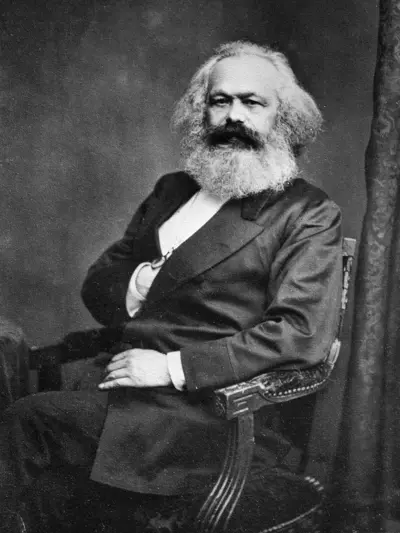
Karl Heinrich Marx was a German philosopher, economist, historian, sociologist, political theorist, journalist and socialist revolutionary. Born in Trier, Germany, Marx studied law and philosophy at university. He married Jenny von Westphalen in 1843. Due to his political publications, Marx became stateless and lived in exile with his wife and children in London for decades, where he continued to develop his thought in collaboration with German thinker Friedrich Engels and publish his writings, researching in the reading room of the British Museum. His best-known titles are the 1848 pamphlet The Communist Manifesto and the three-volume Das Kapital (1867–1883). Marx's political and philosophical thought had enormous influence on subsequent intellectual, economic and political history. His name has been used as an adjective, a noun, and a school of social theory.
