Noam Chomsky Quotes
It happened: the first 9/11, it happened on September 11, 1973, in Chile. We did it. Was that interfering or hacking a party? This record is all over the world, constantly overthrowing governments, invading, forcing people to follow what we call democracy, as in the cases I mentioned. As I say, if every charge is accurate, it's a joke, and I'm sure half the world is collapsing in laughter about this, because people outside the United States know it. You don't have to tell people in Chile about the first 9/11.
Chomsky, Noam. Global Discontents: Conversations on Threats to Democracy. Metropolitan Books, 2017.


The Congress was reacting against the prospect of France supporting a monarchy in Mexico.
At the time our strongest allies in the Middle East were Monarchies, dictatorships, and Principalities. See {586706}


The vice president did not heed his own warning and was one of the major forces starting the Iraq war to take down the Saddam Hussein government.
The American concepts of democracy and human rights have been resented when U. S. policy advocated other nation’s adhering to them.


This statement became known as "The Truman Doctrine." Truman asked for $400 million to help Greece and Turkey fight stave off armed Communist minorities destabilizing their governments.

Most socialists in American and elsewhere initially supported the United States policy of intervention in the Vietnamese civil war. While they disapproved of much of the general economic policy, the Russian, Chinese and other Communist trampling on human rights seemed like a worse alternative.


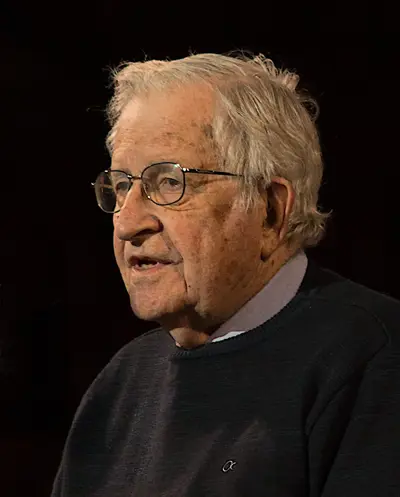
Avram Noam Chomsky is an American linguist, philosopher, cognitive scientist, historian, social critic, and political activist. Sometimes called "the father of modern linguistics", Chomsky is also a major figure in analytic philosophy and one of the founders of the field of cognitive science. He is Laureate Professor of Linguistics at the University of Arizona and Institute Professor Emeritus at the Massachusetts Institute of Technology (MIT), and is the author of more than 150 books on topics such as linguistics, war, politics, and mass media. Ideologically, he aligns with anarcho-syndicalism and libertarian socialism.
