Richard P. Feynman Quotes
It appears that there are enormous differences of opinion as to the probability of a failure with loss of vehicle and of human life. The estimates range from roughly 1 in 100 to 1 in 100,000. The higher figures come from the working engineers, and the very low figures from management. What are the causes and consequences of this lack of agreement? Since 1 part in 100,000 would imply that one could put a Shuttle up each day for 300 years expecting to lose only one, we could properly ask "What is the cause of management's fantastic faith in the machinery? .. It would appear that, for whatever purpose, be it for internal or external consumption, the management of NASA exaggerates the reliability of its product, to the point of fantasy.
Also published in What Do You Care What Other People Think, 1988. This was his last publication. He realized that NASA was under so much political and public relations pressure, that important science issues could not be faced squarely. So he wrote his own appendix to the report which was embarrassing to some of the administrators and contractors but was really appreciated by almost all of the scientists and engineers.
Richard P. Feynman, 1918-1988, Nobel Laureate in Physics, Member, Commission investigating the Challenger accident, Last paragraph of his personal appendix to the Commission Report on the Challenger, June 9, 1986
Sourced by: Eigen's Political and Historical Quotations


In this particular case Griffin was referring to manned space flight, but the principle is a general one. Risk can be managed and in many cases minimized, but can never be eliminated completely unless virtually all activity ceases.


The American space program developed an intellectual schism between those who favored less emphasis on manned space flight and more on automated and robotic probes and those like Franz who thought there should be more manned missions. The manned missions generated the most excitement from the public and tended to get the most public support. The unmanned missions were far less expensive as the multiple layers of safety was not needed to protect lives, they could go one for many years, and they provided much more scientific information. Kranz and many others thought that the movement towards unmanned missions reflected a lack of leadership. Opponents felt that what Kranz wanted was leadership style that did not take sufficient account to the likely scientific contribution for the money spent and placed more value on drama and adventure.

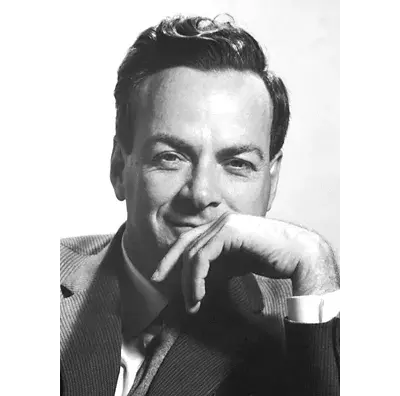
Richard Phillips Feynman was an American theoretical physicist and Nobel Prize winner who made significant contributions to quantum mechanics, quantum electrodynamics, and particle physics. He's known for his work on the Manhattan Project, developing Feynman diagrams, and explaining the interactions between light and matter. While studying for his PhD, Feynman participated in the Manhattan Project and helped develop the atomic bomb. For contributions to the development of quantum electrodynamics, Feynman received the Nobel Prize in Physics in 1965 jointly with Julian Schwinger and Shin'ichirō Tomonaga.
