Tariq Ramadan Quotes
Islamism implies some sort of political and social plan for Muslim people. In that classification, we find different categories. Legalist ones, traditional ones and revolutionary ones. Some of them are revolutionary but are non-violent, others are extremely violent. There are also the ones we call the literalists, like the Egyptian party Hizb al-Nour that used to be against democracy and now is getting into the political game.
Ramadan, Tariq. "Turkey is not the model. Secularists and Islamists are both wrong." Interview by Reset-Dialogues on Civilizations. Reset DOC, 28 May 2013.

The notion that Islam would be practiced by individuals was in the Ayatollah’s view insufficient. Islam must also control the government—the head.


The party to which he was referring was the Ennahda Party of which he was a founder. Note that party's acknowledgement that Islamic extremists had hijacked the terms "Islamic" and "Islamism", thus requiring them to change vocabulary to distinguish themselves and their more democratic values.


Religious obligation of Islam requires all Muslims to try and convert all others. However that is not different from some of the Christian, fundamentalist religions where attempted conversion of non-believers is a duty. However, where many in the Islamic world see that obligation as a peaceful, nonviolent, effort to persuade others to accept Islam, there are many others who believe that Jihad should impose Islamic law—Sharia—upon the world and the use of force and violence is not only acceptable but is necessary and desirable to achieve their objection.


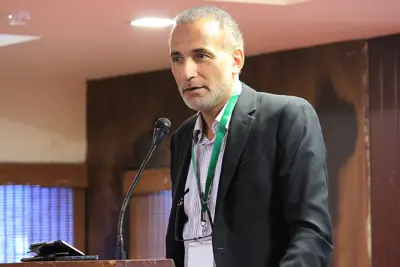
Tariq Ramadan is a Swiss Muslim academic, philosopher, and writer. He was a professor of contemporary Islamic studies at St Antony's College, Oxford and the Faculty of Theology and Religion, University of Oxford, but as of 2018 is taking an agreed leave of absence. He is a visiting professor at the Faculty of Islamic Studies at Hamad Bin Khalifa University in Qatar, and the Université Mundiapolis in Morocco. He is also a senior research fellow at Doshisha University in Japan. He is the director of the Research Centre of Islamic Legislation and Ethics (CILE), based in Doha. He is a member of the UK Foreign Office Advisory Group on Freedom of Religion or Belief. He was elected by Time magazine in 2000 as one of the seven religious innovators of the 21st century and in 2004 as one of the 100 most influential people in the world and by Foreign Policy readers (2005, 2006, 2008–2010, 2012–2015) as one of the top 100 most influential thinkers in the world and Global Thinkers. Ramadan describes himself as a "Salafi reformist".
