Jennifer Doudna Quotes
Is it more ethical to edit embryos or to screen a lot of embryos and throw them away? I don't know the answer.
Isaacson, Walter. The Code Breaker: Jennifer Doudna, Gene Editing, and the Future of the Human Race. Simon & Schuster, 2021, p. 280.


When a couple sought assistance from a fertility clinic, the best medical procedure to fertilize a few female egg cells with sperm. After a few days of development, the seemingly best embryo is selected for implantation in the mother. The others are usually frozen so that they can be used later if there is a miscarriage or the baby dies in childbirth. The Senator and a few other religious fundamentalists believe that the fertilized cell clusters are actually human beings. Therefore if there is a successful birth, the remaining ones should not be used for research using the embryonic stem cells. On the other hand, many are often discarded as most people do not see the cell clusters as a human being but as a potential human being just as a pile of bricks and a truck of cement is not a house but is a potential house if things are done properly.


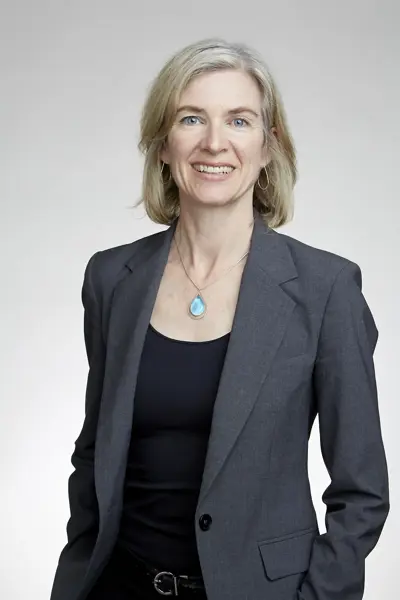
Jennifer Anne Doudna ForMemRS is an American biochemist known for her pioneering work in CRISPR gene editing, for which she was awarded the 2020 Nobel Prize in Chemistry along with Emmanuelle Charpentier. She is the Li Ka Shing Chancellor's Chair Professor in the Department of Chemistry and the Department of Molecular and Cell Biology at the University of California, Berkeley. She has been an investigator with the Howard Hughes Medical Institute since 1997.
