Ron Paul Quotes
Is it any more moral to dilute the value of the purchasing power of the money you hold in your wallet than it is for the farmer to dilute the milk supply with water?
Paul, Ron. End the Fed. Grand Central Publishing, 2009, p. 48.


The exact phrase has not been found in Gresham's writings but the idea appeared in a 1558 letter to Queen Elizabeth I. The expression has come to be known as Gresham's Law.


This is the first major history of banks written in the United States.

Most people owned a little land as most of America were still farmers. They had small amounts of money at different times but spent it for necessities. A relatively few people (mostly in the East) had money—gold and paper currency backed by gold. If the price of property was high, only rich could afford to buy it. The home mortgage system did not then exist, so there was no way that the average land owner could get enough money to buy land to expand farms or buy for children unless the price was low. Today, most land owners want the price of land to be high. The financial system in use at the time makes the difference.


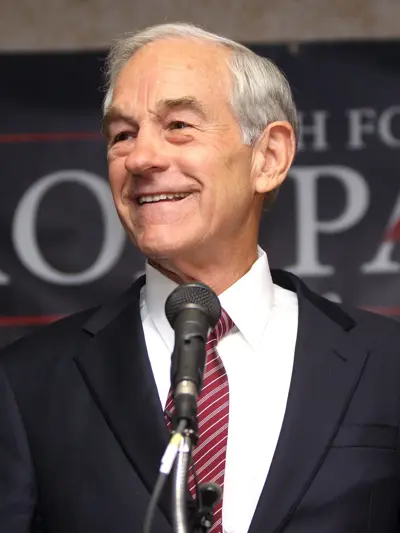
Ronald Ernest Paul is an American author, physician, and retired politician who served as the U.S. Representative for Texas's 22nd congressional district from 1976 to 1977 and again from 1979 to 1985, and for Texas's 14th congressional district from 1997 to 2013. On three occasions, he sought the presidency of the United States: as the Libertarian Party nominee in 1988 and as a candidate for the Republican Party in 2008 and 2012. A self-described constitutionalist, Paul is a critic of the federal government's fiscal policies, especially the existence of the Federal Reserve and the tax policy, as well as the military–industrial complex, the war on drugs, and the war on terror. He has also been a vocal critic of mass surveillance policies such as the USA PATRIOT Act and the NSA surveillance programs. He was the first chairman of the conservative PAC Citizens for a Sound Economy, a free-market group focused on limited government, and has been characterized as the "intellectual godfather" of the Tea Party movement, a fiscally conservative political movement that is largely against most matters of interventionism.
