Peter Pace Quotes
Intelligence we gathered at the time indicated that this was in fact leadership and we struck the leadership.
Pace, Peter. Department of Defense News Briefing. United States Department of Defense, 2002.


No male candidate had before or since been asked such a question.

His concern was well placed. For over half a century thereafter, the tail did wag the dog, and while there have been many successful covert operations, the risk and current pressure siphoned off talent and management attention from intelligence—the Central Intelligence Agency’s primary job.


even though in this case the objective The State Department, the Defense Department and most important President Kennedy had decided to get rid of Diem. Most of the Central Intelligence Agency thought that this was a very unwise policy, because Diem was a known risk, and the people who would replace him and their talents and policies were unknown. The negatives of Diem—the facts that he, a Christian, was persecuting the majority Buddhists, was totally corrupt, and not a very good leader was less distressful to the CIA than to the President and the other agencies as the intelligence agency frequently not only tolerated “offensive” allies, but actually employed them including war criminals. Another importance of this quotation is that it shows that it was by no means certain that the CIA would always follow the orders of the President and the government policy makers. Colby, who was not the agency director at that time but was the head of the South East Bureau, was one high level official who argued that the policies should always be followed even if they were unwise or foolish. Another importance of this quotation is that it illustrate a common error that administrations are frequently forced to make: making a policy decision to eliminate a problem while not having much of an idea of what the alternative or consequence would be when the policy is implemented. The Syrian Civil War in 2013 was a good example. The Government side appeared to have used Chemical Warfare on Civilians and public opinion demanded that we do something. However, having a no-fly zone or any of the alternatives to prevent (punish) the government for the Chemical Warfare would strengthen the rebel side which was made up of numerous factions—some of which were known Islamic fundamentalist terrorists and jihadists. If the balance of power were tipped toward the rebels, the consequence for the American national interests were unknown—just as the consequence of ousting Diem was unknown and turned out to also be bad and was probably worse.

The CIA intelligence had been shared with key world leaders to gain support for the George W, Bush administration invasion of Iraq. Blix was bothered by the fact that although the intelligence was so certain why were not any of the locations known. The answer, of course, was that there was no such development and the intelligence was faulty, but at the time, only he seemed to be bothered by this point. See also {588115}.

See {634917} for a recent example of lying under oath to the Senate.

The major idea of intelligence agencies in a democracy is for the intelligence agencies to provide the policy makers with facts on the ground and data with which they can make sounder policies. However, many times the policies of the administration is so firm that the political ideology restrict not only the kinds of analysis the intelligence agencies do, but in some cases shape or control the conclusions of otherwise sound studies. The influence of Vice President Cheney on the CIA and the invasion of Iraq.


We bombed the building but it was the Chinese embassy. The map and intelligence as to what was in the building was provided as a recommended target by the CIA in another of their serious blunders.

President Roosevelt and Secretary of state Cordell hull felt that a Japanese invasion of the Philippines was a likelihood. The army chief of staff disagreed citing his intelligence reports. Japan of course attacked Pearl Harbor and then invaded the Philippines. Marshall, perhaps America’s greatest military administrator, turned out to be wrong while the President and Secretary of State proved more accurate in their assesment of the Japanese threat. This quotation stands as a testament to the fact that the intelligence fiascoes of the Iraq war are not unique in American military history.


The “adversary” was Pakistan, which was frequently sending military and terrorist attacks into Kashmire much if which has been disputed by Pakistan ever since the Partition of India in 1949. India had a very disciplined and well led military and like most sophisticated military powers did not immediately retaliate for military incursions despite the public pressure to do so. Instead they gave themselves time to plan and organize the logistics for a series of surgical strikes at the terrorist and/or military concentrations Pakistan had deployed close to the border which they launched several days later.


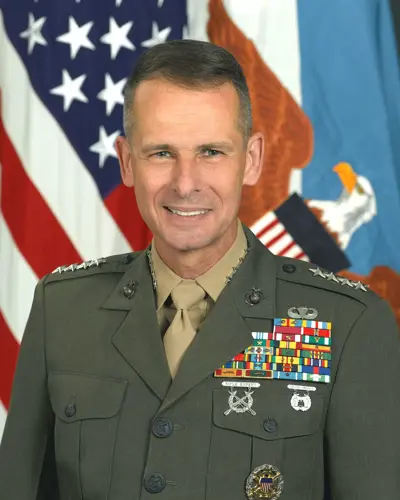
Peter Pace is a retired United States Marine Corps general who served as the 16th Chairman of the Joint Chiefs of Staff. Pace was the first Marine officer appointed as chairman, and the first Marine officer to be appointed to three different four-star assignments; the others as the 6th Vice Chairman of the Joint Chiefs of Staff from October 1, 2001, to August 12, 2005, and as Commander-in-Chief, U.S. Southern Command from September 8, 2000, to September 30, 2001. Appointed chairman by President George W. Bush, Pace succeeded U.S. Air Force General Richard Myers on September 30, 2005.
