Pope Benedict XVI Quotes
Indeed, truth draws strength from itself and not from the number of votes in its favour.
Benedict XVI. "Message of His Holiness Pope Benedict XVI for the 45th World Communications Day." The Holy See, 24 Jan. 2011, www.vatican.va/content/benedict-xvi/en/messages/communications/documents/hf_ben-xvi_mes_20110124_45th-world-communications-day.html.


No other religion has ever preached majority rule so clearly and unambiguously. Because of this strong democratic philosophy, some dictatorial governments see the Bahai as particularly dangerous. Also some religions who see their doctrine and the world of God as being always right and the majority of people should not determine morality are even law. They recognize a higher power. Iran, in particular, has been a terrible persecutor of Bahai, their largest religious minority, which is the antithesis to the concept of a theocracy and at the opposite end of the religious spectrum from Islam. Bahai leaders had been executed. Bahai there are not allowed to attend higher education institutions, build religious facilities, preach openly or serve in many roles. See {614912}.

He was the youngest elected official of Moldova and one of the youngest elected official in the world. He was 23 at the time of the interview.


The world citizenship notion was later articulated by Eugene V. Debs in 1914.


1st Earl of Beaconsfield


Whithead’s view which seems intuitively right to most citizens, tends to be the one that the majority espouses but the minority opposes. At the time, the Republicans controlled the White House and there were a number of polarizing issues, where the Republicans could not obtain consensus and then decided. However, then the Democrats gained control of the White House and Congress the next year, it was the Democrats who claimed that they had to decide. The Republicans, now in the majority, argued that significant changes in America should not be made by narrow majorities and major issues should be tabled if there was no substantial majority. That was the position that the Democrats had espoused when they were in the minority.

This small booklet was the first describing parliamentary procedures and it rapidly sold 500,000 copies. It has become the bases for legislatures, committees, boards ever since. The Congress and most of the State and local legislatures all are based on it.

This illustrated the problem with Nazi Germany where Hitler was elected by the people. In a Constitutional democracy such as the United States, when an elected President attempts to cut away constitutionally insured freedoms, there is public opinion, the press, a Congress and a Supreme Court to check him as occurred in the George W. Bush Administration over wiretapping, torture, and handing of war captives. These were checked, but they were minor and trivial compared to Nazi Germany’s abuse of freedom. In Germany, Hitler weakened or destroyed all those who might check his power and therein lies the essential difference. The despot must eliminate or weaken the checks on him. In the American democracy, the Congress finally checked John Adams’ Alien & Sedition Act as did public opinion by turning him out of office after one term. But in each case, in democracy or dictatorship, the same argument is often made if the elected leader impinges on some freedoms: it is legitimate because he represents the will of the people. Spencer and many others have always disagreed.


In early WWII, he opposed the Japanese military practice of killing conquered civilian people to instill fear and make them accept occupation. (In this case in occupied Indonesia). He was arrested by the military and sentenced to death, but he never was executed. Though not generally known, there were a number of Japanese who opposed the Japanese military policies and practices. He was one.
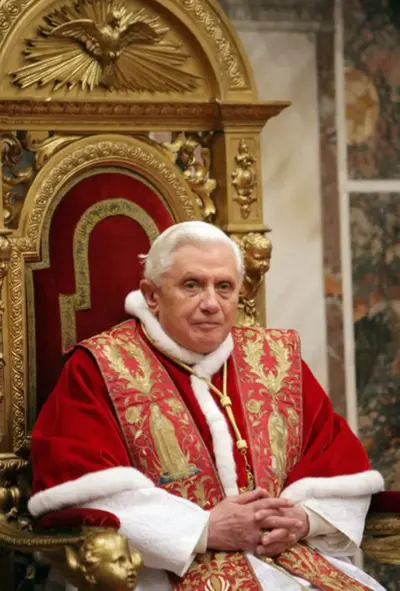
Pope Benedict XVI is a retired prelate of the Catholic Church who served as the head of the Church and the sovereign of the Vatican City State from 2005 until his resignation in 2013. Benedict's election as pope occurred in the 2005 papal conclave that followed the death of Pope John Paul II. Benedict chose to be known by the title "pope emeritus" upon his resignation.
