Charles Lindbergh Quotes
In wilderness I sense the miracle of life, and behind it our scientific accomplishments fade to trivia.
Lindbergh, Charles A. "The Wisdom of Wildness." Life, vol. 63, no. 25, 22 Dec. 1967, p. 10.


Proenza was giving an explanation of why he had “blown the whistle” on the Department of Commerce over the QuickScat weather satellite. QuickScat, was the satellite that the Hurricane Center used to give early warnings about hurricanes and other tropical storms. However in 2007 it was still in service although it was only designed for a shorter period than it had already been functioning. Proenza and other scientists at NOAA reported that the satellite could fail at any time and leave the nation without an equivalent predictive tool. There had been a government plan to replace the satellite with a new one, but the cost was $400 million, but the Bush Administration had cut taxes massively and had gone from the Clinton budget surplus to the largest deficit then in American history. The administration told all senior officials that they should not tell Congress or the public that they needed any more money. When Proenza went public because he thought that people could easily die for lack of predictive capability of hurricanes, the George W, Bush administration suspended him for speaking out and not being loyal to the President and his administration. His loyalty was to the lives and safety of the American people and not to any politicians.


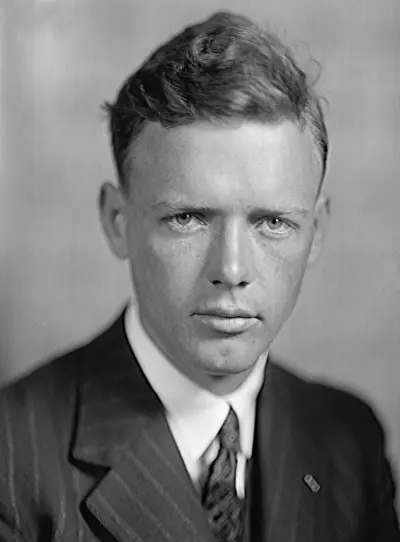
Charles Augustus Lindbergh, nicknamed Slim, Lucky Lindy, and The Lone Eagle, was an American aviator, author, inventor, military officer, explorer, and social activist. In 1927, at the age of 25, Lindbergh emerged from the virtual obscurity of a U.S. Air Mail pilot to instantaneous world fame as the result of his Orteig Prize-winning solo nonstop flight from Roosevelt Field on Long Island, New York, to Le Bourget Field in Paris, France. He flew the distance of nearly 3,600 statute miles (5,800 km) in a single-seat, single-engine, purpose-built Ryan monoplane, Spirit of St. Louis. Lindbergh was the 19th person to make a Transatlantic flight, the first being the Transatlantic flight of Alcock and Brown from Newfoundland in 1919, but Lindbergh's flight was almost twice the distance. The record-setting flight took 33 1⁄2 hours. Lindbergh, a U.S. Army Air Corps Reserve officer, was also awarded the nation's highest military decoration, the Medal of Honor, for his historic exploit. Politically, the National Hero became an active fascist supporter of Mussolini and Adolph Hitler who awarded him a Medal for Supporting Fascism, Anti-Semitism and advocating for America to allow Hitler to conquer German and the rest of Europe. After WWII he was in disgrace.
