Yasser Arafat Quotes
In view of the promise of a new era and the signing of the Declaration of Principles and based on Palestinian acceptance of Security Council Resolutions 242 and 338, the PLO affirms that those articles of the Palestinian Covenant which deny Israel's right to exist, and the provisions of the Covenant which are inconsistent with the commitments of this letter are now inoperative and no longer valid. Consequently, the PLO undertakes to submit to the Palestinian National Council for formal approval the necessary changes in regard to the Palestinian Covenant.
This was a major historical breakthrough. The PLO had finally accepted the right of Israel to exist. The PLO changed some of the offensive parts of their Constitution but Arafat reneged on making all the changes.
Yasser Arafat, 1929-2004, Chairman, Palestine Liberation Organization, Letter of September 9, 1993 to Israeli Prime Minister Yitzhak Rabin
Sourced by: Eigen's Political and Historical Quotations

The Palestinians were split between supporters of Hamas and Fatah. The former was a terrorist organization which refused to recognize the right of Israel to exist and whose charter called for the killing of all Jews. The latter, accepted the right of Israel to exist and was committed to peace and coexistence with the Jewish state. They had fought a civil war and Hamas controlled Gaza with well over 1 million people which they seized for force and killed of forced out Fatah Representatives. Fatah was the elected ruling party of the West Bank, the larger and more populous of the Palestinian territories. There was little chance of any peace given that split. However, Israel which had undergone over 7000 rockets fired upon them by Hamas, stated that they refused to negotiate with the Palestinians as long as the Hamas terrorists were a part of the control of the potential Palestinian state. They would only discuss a 2 state solution if Hamas agreed that they accepted the right of Israel to exist in their general territory as a Jewish State, Hamas would accept and follow previous agreements made with the Palestinians, and Hamas would give up terrorism and the objective of killing Jews. So either Hamas would have to change its policies or Israel would negotiate with an organization that claimed it would never accept the existence of that country as a Jewish state. Al-Masri thought that the agreement he had mediated, was a necessary first step and was constructive for all the parties.


For years of the Arab-Israeli conflict, Palestinians would never negotiate with Israel over anything. Finally that barrier was broken and, the PLO became a negotiating party with Israel. However, the terrorist organization Hamas, had challenged the PLO for political control of the Palestinians and then took over the Gaza strip—part of the Palestinian territory. They then shot thousands of rockets into Israel, a clear act of war under international law. The Israelis then attacked the Hamas infrastructure and any building of facility where they had command or communications, meetings, trainings or stored weapons or ammunitions. The Gazans suffered many more casualties than the Israelis—about 20 to 1 ratio. Many other countries tried to broker a ceasefire which the Israelis agreed to but Hamas would not. The Israeli ambassador was asked on American television if Israel would be willing to negotiate on the larger issues of the conflict as they had negotiated with the PLO. This was his reply. The major problem was that the Hamas Charter had two clauses that made negotiations impossible. Hamas was committed to the destruction of Israel and would not agree that the Israel had a right to exist. Second, the Hamas charter called for the killing of Jews anywhere in the world—men, women and children. The Israelis asked what they would negotiate about given those two charter items and the Hamas terror history in killing as many Israelis as they could.

One of the characteristic of many Muslim leaders is their willingness to sacrifice the lives of their people for political objectives. This has been supported by a willingness of a significant minority of the Muslim population to sacrifice their lives—especially when the leaders have been skilled enough to link their political objectives to the welfare and survival of Islam.


The quotation was made in the context of the Arab Israeli conflict, but the principle is general.


At the time YaAlon was Rabin’s Chief of Intelligence.


He and the government had just given the OK for a targeted assassination of the Palestinian terrorist who had designed the bombs and recruited the suicide bombers which led to the deaths of over 100 Israelis. Shortly thereafter, a cell phone the engineer was using blew up killing him by the same method whereby he had killed so many. This was the first targeted assassination of terrorist leaders, which then became an operational policy.


In the complicated and arcane Middle East, substantial majorities of Israelis and Palestinians both favored a two state solution, thus creating a Palestinian State out of the West Bank and Gaza. However, the Hamas terrorist organization won the majority of seats in the Parliament and formed the “government” of the Palestinian Authority. Hamas opposed Israel’s right to exist at all, as that position as well as virulent Anti-Semitic threats to all Jews in the world. Many called for Hamas to change their charter and crease their opposition to the right of Israel to exist. The President of the Palestinian authority called for new elections but Hamas refused. Thus Blair and other diplomats the world over were in a very difficult situation.


This resolution has never been rescinded. Some Arab states have abandoned this resolution and negotiated peace and recognition such as Egypt. The majority of the Arab States did and do not want peace with Israel. They did and do not want to recognize Israel and they did and do not want to negotiate. But they often blame Israel for being intransigent in the peace process. Many Arabs want a peace treaty and want to negotiate but the extreme rejectionists generally dominate Arab politics.

A major issue amongst Israeli’s is to how they should relate to those hostile Islamic nations in their area who claim they are at war with Israel or the Jewish People. This position in effect says that the oratory of those Islamic groups that claim that they are in a war—a holy war even—should be taken at their word and treated as a wartime enemy and Israel should actively attempt to kill and destroy them.


At that time the Israelis had been rebuffed after offing several major peace proposals and most were convinced that the Palestinians were so fractionated that no one would dare sign a peace even giving Palestinians their own state and sharing Jerusalem as the capital. So they just organized around security needs and walling Israel off from terrorist attacks while maintaining the occupation until something radially changes amongst the Palestinians. The Palestinians and the other Arabs did not want to negotiate either as they felt so weak that they believed they could never get decent terms, and they hoped for some military or terrorist victories where the Israelis would make large concessions to a strong opponent. At the same time there were a few ultra-orthodox Jews who did not want a peace and wanted to do what conquering nations had done throughout history—annex more conquered territory. There were a number of Arab groups, in addition to some Palestinians who did not want a peace at all, as for them there was no satisfactory solution so long as there was a Jewish state in their midst. See {632822} for more on the Israeli attitude then.

At that time the Israelis had been rebuffed after offing several major peace proposals and most were convinced that the Palestinians were so fractionated that no one would dare sign a peace even giving Palestinians their own state and sharing Jerusalem as the capital. So they just organized around security needs and walling Israel off from terrorist attacks while maintaining the occupation until something radially changes amongst the Palestinians. At that time there was little point to most Israelis to debating terms of a peace treaty as the odds of ever getting one in the next couple of years were about the same as their going to Mars.
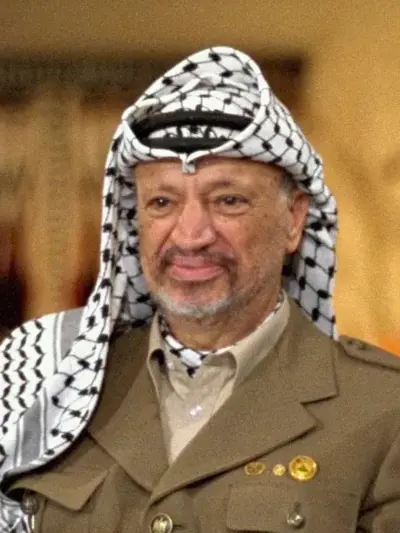
Mohammed Yasser Abdel Rahman Abdel Raouf Arafat al-Qudwa al-Husseini, popularly known as Yasser Arafat (Arabic: ياسر عرفات, romanized: Yāsir ʿArafāt) or by his kunya Abu Ammar (Arabic: أبو عمار, romanized: ʾAbū ʿAmmār), was a Palestinian political leader. He was Chairman of the Palestine Liberation Organization (PLO) from 1969 to 2004 and President of the Palestinian National Authority (PNA) from 1994 to 2004. Ideologically an Arab nationalist, he was a founding member of the Fatah political party, which he led from 1959 until 2004.
