Woodrow Wilson Quotes
In the view of this Government there cannot be any common ground upon which it can stand with a Power whose conceptions of international relations are so entirely alien to its own, so utterly repugnant to its moral sense. There can be no mutual confidence or trust, no respect even, if pledges are to be given and agreements made with a cynical repudiation of their obligations already in the mind of one of the parties. We cannot recognize, hold relations with, or give friendly receptions to the agents of a Government which is determined and bound to conspire against our institutions, whose diplomats will be the agitators of dangerous revolt, whose spokesmen say that they sign agreements with no intention of keeping them.
Woodrow Wilson, 1856-1924, 28th President of the United States (Democrat, NJ), Note on the reasons for not recognizing the new Communist government of Russia, 1919
Sourced by: Eigen's Political and Historical Quotations

Like many in the 1920s, Dewar saw the Communist Soviet Union as the biggest potential risk to peace. However, although the Russian leaders constantly castigated the West, they did not have a large military, and were for the most part highly anti-war as they saw war as the product of Capitalistic competition and the tool of the aristocracy. They had little military equipment and almost no training or officer corps with which to build any Army. Germany in contrast had the skill, experience, officers, a history of aggression, and huge resentment over what they considered their humiliating WWI defeat and peace terms. They would start WWII, not Russia.


Pakistan while feigning alliance during the Afghanistan War was actually supporting terrorist groups and giving safe haven to the Taliban. America poured billions into Pakistan much of which was siphoned off by corruption and much of the money actually funded the Pakistani Intelligence Service which was supporting terrorist groups who in turn were attacking Americans in Afghanistan. Pakistan was paranoid about India and used terrorist groups to harass and attack that country. America had been a little reluctant to form a strong alliance with India as during the cold war they were neutral and did not support us. But it was a real democracy, as opposed to Pakistan, and not duplicitous like Pakistan had been.


See {640831} for more on this subject.


This quotation illustrates White’s extreme naivety about Stalinist Russia. At the time the Soviet Union had been backing communist insurgencies blatantly in China, Greece, and Korea for example. Most historians agree that White passed classified information to the Russians. He was accused of being a Communist, but there was never any evidence of that. Some people believe that he was a spy for the Russians and committed espionage, but others disagree observing that White was very much his own man and felt that much information that was classified never should have been. White substituted his own judgment, it is believed, about what could be given to the Russians. He was an admirer of what Russian socialism had accomplished economically, educationally and medically since the 1917 revolution deposing the Czar. Russia had been a valuable military ally, which had taken the brunt of both military and civilian casualties in WWII. White’s economics were certainly not Marxist but very much Keynesian. He was subpoenaed by the House Un-American Activities Committee where he was accused of being a Communist which he denied (see {634907}). He died of a heart attack 3 days later.


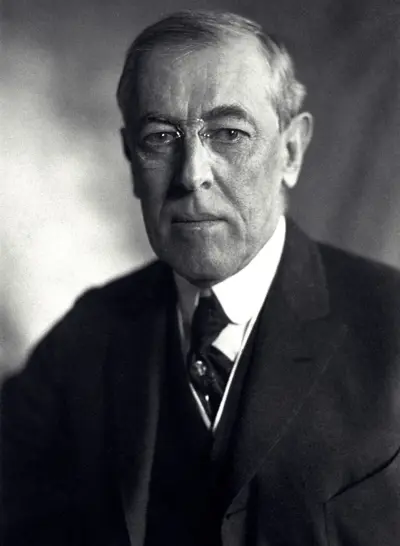
Thomas Woodrow Wilson was an American politician and academic who served as the 28th president of the United States from 1913 to 1921. A member of the Democratic Party, Wilson served as the president of Princeton University and as the 34th governor of New Jersey before winning the 1912 presidential election. As President, Wilson led the United States into World War I in 1917. He was the leading architect of the League of Nations, and his progressive stance on foreign policy came to be known as Wilsonianism. Scholars have generally ranked Wilson in the upper tier of U.S presidents, although he has been criticized for supporting racial segregation and white supremacy.
