R. Nicholas Burns Quotes
India will be a more reliable and trusting partner than Pakistan has ever been.
Pakistan while feigning alliance during the Afghanistan War was actually supporting terrorist groups and giving safe haven to the Taliban. America poured billions into Pakistan much of which was siphoned off by corruption and much of the money actually funded the Pakistani Intelligence Service which was supporting terrorist groups who in turn were attacking Americans in Afghanistan. Pakistan was paranoid about India and used terrorist groups to harass and attack that country. America had been a little reluctant to form a strong alliance with India as during the cold war they were neutral and did not support us. But it was a real democracy, as opposed to Pakistan, and not duplicitous like Pakistan had been.
R. Nicholas Burns, United States Under Secretary of State for Political Affairs, “Passage to India”, Foreign Affairs, September / October 2014
Sourced by: Eigen's Political and Historical Quotations


At the time Pakistan was almost a failed state which had nuclear weapons. They took large amounts of American aid (military and civilian) and claimed that they were an ally in the War on Terror. On some occasions they deployed their troops against fundamentalist terrorists. On others they shielded terrorists and provided them with sanctuary from attack, intelligence and allowed terrorist leaders to not only live in Pakistan but operate their organizations from Pakistan. They supported radical Madrassas (religious schools) that taught hate and terrorism, and armed terrorists in the hopes that they could be used against their enemy India while the terrorists themselves killed more Pakistanis by far than the Indians ever did. The civilian government was subservient to the military which itself was subservient to the Intelligence Arm.

A few years later, the Iranian revolution transformed our ally to whom we had sold arms. Then Iran-Contra reopened the issue of arms and Iran.


Al Qada and Taliban insurgents fighting in Afghanistan had a sanctuary for training and resupply in the rugged mountains of Pakistan near the Afghan border. Many American military and policy makers believed that we did need Pakistan to close down the sanctuaries and lines of supply if the war was to end. However, the Pakistanis, as Mr. West stated, extracted much from the United States while at the same time, not only refusing to try to control their frontier, but several elements of the Pakistani government were actually assisting the Taliban and Al Qada while taking U. S. Military Aid to suppress them.

The 21st century perception of Pakistani leaders was not new. The same delusional view of the nation’s importance was held by the founder of Pakistan from the start of nation. The perception of American leaders has been on both sides of this question at different times. The reality is that Pakistan and the United States have both profited from the relationship, but there is constant reevaluation in both nations as to whether the price that is paid for the relationship is worth the cost.
_0_PostageStamp_47x47.jpg "Chairman of the Joint Chiefs of Staff Navy Adm. Mike Mullen gives an interview to John Dickerson during the CBS news program Face the Nation in Washington, D.C., July 5, 2009. During the interview, Mullen discussed the wars in Iraq and Afghanistan, North Korea's recent missile tests and his recent visit to Russia. (DoD photo by Mass Communication Specialist 1st Class Chad J. McNeeley, U.S. Navy/Released)")


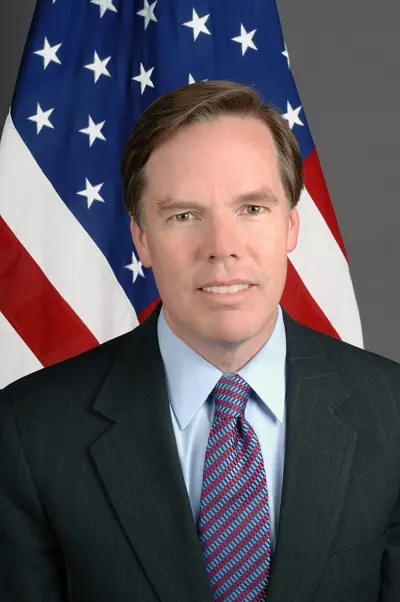
R. Nicholas Burns is a university professor, columnist, lecturer and former American diplomat. He is currently Professor of the Practice of Diplomacy and International Politics at Harvard's John F. Kennedy School of Government and a member of the Board of Directors of the school's Belfer Center for Science and International Affairs. At the Harvard Kennedy School, he is director of The Future of Diplomacy Project and Faculty Chair for the programs on the Middle East and India and South Asia. He is Director of the Aspen Strategy Group, senior counselor at The Cohen Group and serves on the Board of Directors of Entegris, Inc.
