Noam Chomsky Quotes
In the late 1990s, some of the worst terrorist atrocities in the world were what the Turkish government itself called state terror, namely massive atrocities, 80 percent of the arms coming from the United States, millions of refugees, tens of thousands of people killed, hideous repression, that's international terror, and we can go on and on.
Chomsky, Noam. 9-11. Seven Stories Press, 2001.


Mensheviks were the opposition political party to the Bolsheviks. Lenin used Ethnic Cleansing and deportation to gain control of areas where Mensheviks had and established following. It was so ruthlessly effective, that shortly thereafter the Mensheviks were no a significant force and the entire country was Bolshevik. Today, few people even know what a Menshevik was.


This statement caused great consternation. NcNutt did try to explain that he was speaking personally and not for the Government, but there was a small proportion of America who had concluded that all Japanese should be killed. Such an concept which was unthinkable 5 years earlier was considered as a result of several factors: The Japanese had murdered many American prisoners of war. Killed millions of civilians throughout Asia including doing medical and weapons experiments on live human beings. They had practiced torture, compulsory prostitution and mass rape of conquered territories. At the same time, the Germans had tried to exterminate all the Jews and, with some Japanese help, did kill two-thirds. The concept of genocide had been introduced to Americans as the concentration camps were liberated. And American casualties in the Pacific had been heavy. Vengeance was desired by many. Fortunately, the overwhelming majority of Americans never considered genocide seriously.


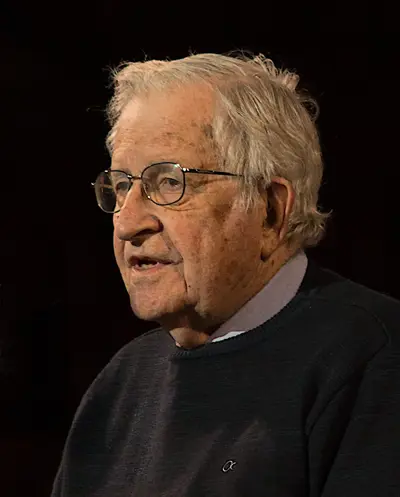
Avram Noam Chomsky is an American linguist, philosopher, cognitive scientist, historian, social critic, and political activist. Sometimes called "the father of modern linguistics", Chomsky is also a major figure in analytic philosophy and one of the founders of the field of cognitive science. He is Laureate Professor of Linguistics at the University of Arizona and Institute Professor Emeritus at the Massachusetts Institute of Technology (MIT), and is the author of more than 150 books on topics such as linguistics, war, politics, and mass media. Ideologically, he aligns with anarcho-syndicalism and libertarian socialism.
