Albert Einstein Quotes
In the beginning (if there was such a thing), God created Newton's laws of motion together with the necessary masses and forces. This is all; everything beyond this follows from the development of appropriate mathematical methods by means of deduction.
Einstein, Albert. "Autobiographical Notes." Albert Einstein: Philosopher-Scientist, edited by Paul Arthur Schilpp, Library of Living Philosophers, 1949, p. 19.

The religious theology of the Church of England had accepted the fact based on Newton’s work, that the heavenly bodies followed a set of scientific laws that were themselves created by God. However, the Church could not accept the same principle when it came to the different species of humans and lower order animals. Each species they believe was created with all its characteristics by God directly and species could not change, develop, regress, go extinct unless God specifically ordained that. It was this inconsistency that Darwin was afraid would produce religious attacks on him and his notions of natural selection while astronomy and physics was treated very different theologically. Darwin delayed publishing his findings for 25 years hoping to find a religious atmosphere that would treat biology much as physics and astronomy. It didn’t come and finally he published and took the heat, which actually was not very great. With the exception of some religious fundamentalists, most other elements of society welcomed and supported Darwin’s ideas which today we realize were among the most important ever put forth in the world of science.


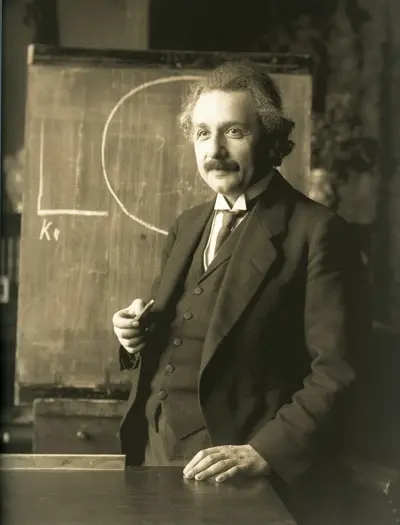
Albert Einstein was a German-born theoretical physicist, widely acknowledged to be one of the greatest physicists of all time. Einstein is known for developing the theory of relativity, but he also made important contributions to the development of the theory of quantum mechanics. Relativity and quantum mechanics are together the two pillars of modern physics. His mass–energy equivalence formula E = mc2, which arises from relativity theory, has been dubbed "the world's most famous equation". His work is also known for its influence on the philosophy of science. He received the 1921 Nobel Prize in Physics "for his services to theoretical physics, and especially for his discovery of the law of the photoelectric effect", a pivotal step in the development of quantum theory. His intellectual achievements and originality resulted in "Einstein" becoming synonymous with "genius".
