Yanis Varoufakis Quotes
In occupied Iraq, the introduction of new paper money took almost a year, 20 or so Boeing 747s, the mobilisation of the U.S. military's might, three printing firms, and hundreds of trucks.
Varoufakis, Yanis. "The Drachma Illusion." Project Syndicate, 24 July 2015.

See {583710} for his grandchild’s variation.


In the 1830's paper money was issued by many public and private agencies. The Mormons, among others, didn't trust the banking system or the Bank Notes of the time. They formed their own organizations and issued Anti_Bank Notes.

Attempting to defend charges that his bank and others were engaged in monopolistic practices:


The alternative would have been for the colonies to borrow English money at high interest rates and use that. Or use money from private banks (which occurred later.) Many conservatives are today a little shocked that some of the American Colonies just printed money with no backing but it worked—at least at the local level. A Boston Bank for example, would take a large commission for a Bostonian to convert Pennsylvania money into Massachusetts money. So it was not a very good system for trade between colonies and International trade. But English money was used for that. The colonists pragmatically got the “best of both worlds” and paid as little interest as they needed to. This system is essentially what we use today on a national scale with no gold or silver backing of the money.

He was against paper money. At the time, any bank could issue its own paper money or “banknotes”. However other banks would not redeem the banknotes for the full amount; they would “discount” the note. Usually, the further away the bank was from the original bank, the more discount they took. Interstate commerce was almost impossible. Alexander Hamilton, Jefferson’s nemesis, had a much more modern point of view and fortunately his view prevailed. Paper money could only work if it was issued by a central bank with no discounting by other banks. The paper money had to be “legal tender”.

At the time any private bank could issue their own money. Private sector bankers thought it outrageous that the Congress should consider trampling on their rights to issue money. The solution that was finally adopted some years later was to use the Federal Reserve Board to control the money supply. It is independent of the Congress and the President but members are appointed by the President and confirmed by the Senate. Our system, like no other system, is a compromise where neither the Government or the Private Sector controls the American money supply.
This is a remarkable quotation in that it proposed exactly what the United States did in the Nixon administration. We went off the gold standard and backed American money with the wealth and “full faith and credit” of the nation and all its assets. It has been the strongest and most sought after currency in the world despite the fact that it is not backed by gold or silver as earlier American currency was.


At the time there was no national paper money. Individual banks printed their own and paper money was not accepted or heavily discounted most Americans. Most opposed a tender law that required paper money to be accepted in commerce.


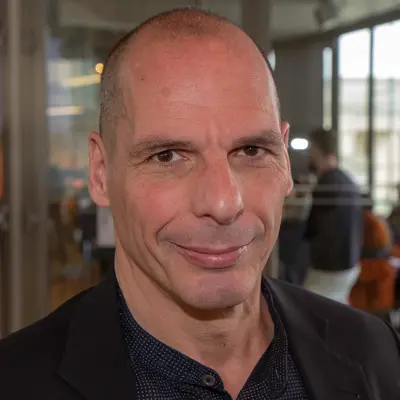
Ioannis "Yanis" Varoufakis is a Greek-Australian economist and politician. A former academic, he has been Secretary-General of MeRA25, a left-wing political party, since he founded it in 2018. A former member of Syriza, he served as Minister of Finance from January to July 2015 under Prime Minister Alexis Tsipras. Varoufakis was a member of the Hellenic Parliament for Athens B from January to September 2015; he regained a parliamentary seat in July 2019.
