Elvira Nabiullina Quotes
In my view, the key aim of economic policy in many countries, and particularly in Russia, should be the sort of policy that stimulates productivity growth because only on the basis of growth of labour productivity can we enjoy healthy growth.
Nabiullina, Elvira. "CNBC Transcript: Elvira Nabiullina, Governor, Bank of Russia." Interview by Geoff Cutmore. CNBC, 21 June 2013.


Iceland's economy collapsed in the Meltdown of 2008. Their largest banks failed completely as they had engaged in the same kind of risky investments as the American banks had. Their government however did not have the assets to bail their banks out. So they let the banks fail and protected the small depositors with their limited assets. They then devalued their currency drastically, making their fishing and other products a great bargain for other nations of the world and though humiliated the Islanders started getting jobs as demand for Islandic exports grew. Some Icelanders who owned companies were making a great deal of money. Taxes were raised for high income citizens. To prevent the money being taken out of the country and invested so that the jobs would not benefit Icelanders or the earnings were not as taxable in Iceland, the nation imposed Capital Controls—no money was allowed to be taken out of the country except small amounts for business travel expenses. Iceland recovered rapidly and by 2015, at which point the Minister of Finance felt that the country was losing more than it was gaining, so it was time to end the Capital Controls.


This quotation is important as it provides a major counter-example to the ideological political belief that tax cuts and deregulation produce economic growth. Sometimes they do, but other times they do not. Ironically the greatest periods of growth in the last half of the 20th century included some of the highest rates of taxes. At other times high taxes curtailed growth. As with many political ideologies, they are really not principles or laws of nature or economics, but political preferences.


At the time, the economy was virtually controlled by the banks and others in the finance, as opposed to businesses that produced things or provided non-financial services to consumers and business which was that had prevailed ever since the Great Depression, when New Deal legislation controlled the banks, stock markets, and other facets of the financial industry.


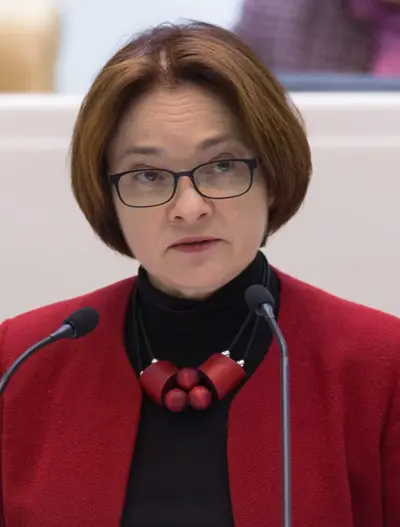
Elvira Sakhipzadovna Nabiullina is a Russian economist and head of the Central Bank of Russia. She was Russian President Vladimir Putin's economic adviser between May 2012 to June 2013 after serving as minister of economic development and trade from September 2007 to May 2012. As of 2019, she is listed as the 53rd most powerful woman in the world by Forbes.
