Ruhollah Khomeini Quotes
In Islam, democracy is included and people are free in Islam, both in expressing their opinions and their actions, until there is no conspiracy and they don't bring up ideas which would deviate Iranian generation.
Khomeini, Ruhollah. Interview with Der Spiegel, 7 Nov. 1978. Sahifeh-ye Imam, vol. 4, The Institute for Compilation and Publication of Imam Khomeini's Works, 2001, p. 248.

They are so different that most people in the West think of what Khamenei describes as “religious democracy” as not even close to democracy—almost the antithesis of democracy, and Islamic fundamentalists perceive Western democracy as sinful and evil.


Over 1000 people had registered to be candidates in the Iranian national election. However, under the Iranian Islamic Constitution all candidates have to be approved by the Guardian Council of Ayatollahs who are appointed by the Supreme Leader, also appointed. The Guardian Council found that all candidates but 6 were not worthy enough Muslims to be allowed to run for public office. 2 of the over 1000 rejected candidates were very prominent Iranians. The Supreme Leader made this statement which seems very reasonable and democratic until his order to the Guardian Council is considered. He ordered them to reconsider 2 or the 1000 rejected candidates.

This quotation of a very popular Muslim cleric illustrates the wide range of political views of Islamic leaders and authorities. Whereas most shun democracy as placing public opinion over the word of God, there are many like al-Qaradawi who have a modernist interpretation of Islam.


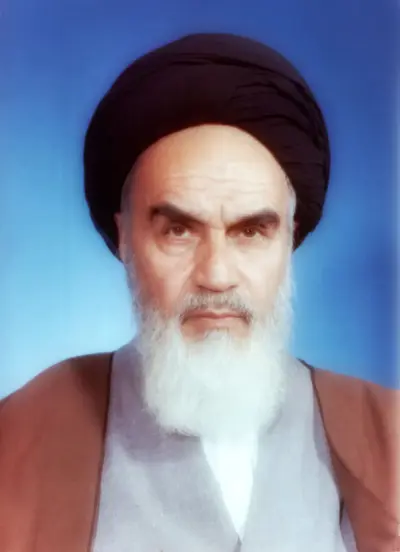
Sayyid Ruhollah Musavi Khomeini, also known in the Western world as Ayatollah Khomeini, was an Iranian political and religious leader. He was the founder of the Islamic Republic of Iran and the leader of the 1979 Iranian Revolution, which saw the overthrow of the last Shah of Iran, Mohammad Reza Pahlavi, and the end of the 2,500-year-old Persian monarchy. Following the revolution, Khomeini became the country's Supreme Leader, a position created in the constitution of the Islamic Republic as the highest-ranking political and religious authority of the nation, which he held until his death. Most of his reign was taken up by the Iran–Iraq War of 1980–1988. He was succeeded by Ali Khamenei on 4 June 1989.
