Elizabeth Cady Stanton Quotes
In her present ignorance, woman's religion, instead of making her noble and free, by the wrong application of great principles ofright and justice, has made her bondage but more certain and lasting, her degradation more hopeless and complete.
Stanton, Elizabeth Cady, et al., editors. History of Woman Suffrage. Vol. 1, Fowler & Wells, 1881.


Sharie is the Islamic code of law based on the Koran which is so brutal that they would stone a woman to death who had illicit sex or kill someone who wanted to change his religion.

Dr. Saadawi was fired from her government post for revealing the status of women in the country. She was also actually arrested and jailed as well for impairing national “values.” See .{586709}.

The secular government and the equal rights of women which transformed Turkey into a modern state under Ataturk had its roots with others in addition to Attaturk, Riza was the one who lead the parliament. Despite the Koran and Islamic tradition, polygamy was later abolished in Turkey—the first Islamic state to have done so since the founding of the religion.


The speaking to which she was referring was Christian Religious preaching by women. At the time it was considered by most Christians to be sacrilegious for women to preach. This came down from the orthodox Jewish tradition, and there are several passages in the New Testament where the Apostles, who were Jews themselves were echoing the religious tradition. This then took on a meaning that went beyond tradition as in Judaism. Margaret Fox wrote this essay which was a completely theological defense of a woman’s right – indeed obligation—to preach. Theologically, there are many Christian churches for whom her argument would be too radical—even in modern times. However, in the middle of the 17th century to most male clerics, this was so unfathomable that they did not even deign to refute her theological arguments. Meanwhile, the Quakers began to accept women in theological positions of influence—for ahead of most other Christian and Jewish sects. See {619836} and {619837} for quotations from the essay itself.
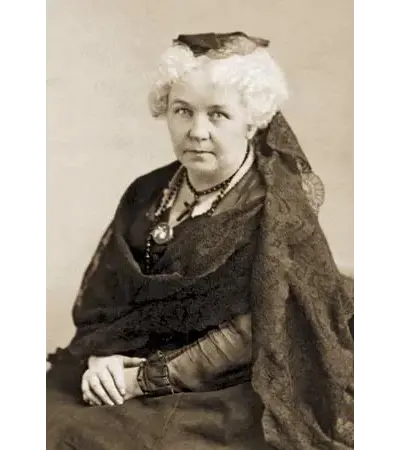
Elizabeth Cady Stanton was a leader of the women's rights movement in the U.S. during the mid- to late-1800s. She was the main force behind the 1848 Seneca Falls Convention, the first convention to be called for the sole purpose of discussing women's rights, and was the primary author of its Declaration of Sentiments. Her demand for women's right to vote generated a controversy at the convention but quickly became a central tenet of the women's movement. She was also active in other social reform activities, especially abolitionism.
