Werner Heisenberg Quotes
In America, it was decided to attempt the production of atomic bombs with an effort that would constitute a large part of the collective American war effort. In Germany, an effort one thousandth the scale of the American was applied to the problem of producing atomic energy that would drive engines.
Heisenberg, Werner. "Research in Germany on the Technical Application of Atomic Energy." Nature, vol. 160, no. 4059, 1947, p. 212.


Bethe and other European refugees joined American and British scientists at Los Alamos, NM, for the development of the atomic bomb.


The bombing of Tokyo to which she referred, killed over 100,000 Japanese in a single raid, more than each of the two atomic bombs. However, those who, in hindsight, raise the issue of the morality of using the atomic bombs, say nothing about the firebombing. The graphic is of Dr. Libby when she was working with Enrico Fermi to create the first nuclear chain reaction to prove the feasibility of a nuclear bomb. She was the only female on the team.


Rutherford had been the first to split the atom in 1919.


Meitner and her nephew Frisch had been the first people to realize that the atom had been split. Meitner had described the process to her nephew and he made some drawings of the process she described. A few of these looked like a bacteria dividing. Frisch happened to meet with William A. Arnold, an American Biologist doing research in Stockholm. He asked Arnold what the biologists called it when a bacteria divided, and he replied, “fission”. Frisch told his aunt and she decided that they should use that term in the scientific article they were preparing on the splitting of the atom.

Morrison was then a graduate student of Oppenheimer. The quotation is important, not because it shows how quickly the “father of the atomic bomb” realized that a nuclear bomb could be made and how, but how relatively easy and rapid it was for a competent theoretical physicist could conceptually design a nuclear weapon if they first had knowledge of the Hahn / Strassmann Experiment and the Meitner / Frisch explanation of what had happened ({640924}). Note Leo Szilard’s letter at about the same time--{640925}.


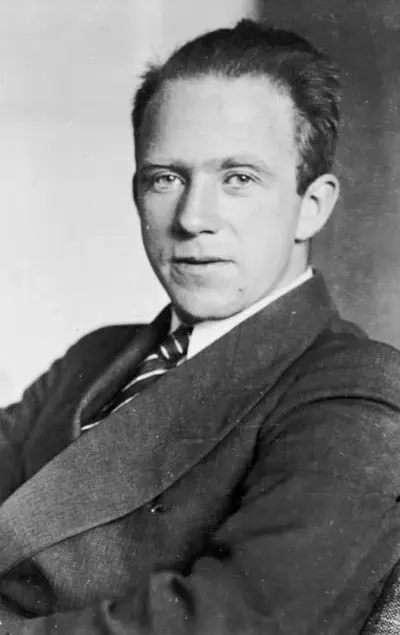
Werner Karl Heisenberg was a German theoretical physicist and one of the key pioneers of quantum mechanics. He published his work in 1925 in a breakthrough paper. In the subsequent series of papers with Max Born and Pascual Jordan, during the same year, this matrix formulation of quantum mechanics was substantially elaborated. He is known for the uncertainty principle, which he published in 1927. Heisenberg was awarded the 1932 Nobel Prize in Physics "for the creation of quantum mechanics".
