Andrew Jackson Quotes
In a country where offices are created solely for the benefit of the people no one man has any more intrinsic right to official station than another. Offices were not established to give support to particular men at the public expense. No individual wrong is, therefore, done by removal, since neither appointment to nor continuance in office is a matter of right.
Andrew Jackson, 1767-1845, 7th President of the United States (Democrat, TN), First State of the Union Address, December 1829
Sourced by: Eigen's Political and Historical Quotations


See Charles James Fox, John Milton, Jeremy Bentham, George Mason, Henry Clay, Benjamin Disraeli and Woodrow Wilson for similar expressions of this idea.

See Charles James Fox, John Milton, Jeremy Bentham, George Mason, Grover Cleveland, Benjamin Disraeli and Woodrow Wilson for similar expressions of this idea.

See Edmund Burke and Franklin Delano Roosevelt for a similar view.


“Public charities” were government services that were like those provided by private charities: relief, food, housing etc. ie “welfare”


The hearings were on indecency in broadcasting.


The first non-PRI President in over 70 years. Before Fox, the corruption of Mexican Presidents was rampant.

Many people have erroneously credited the water’s edge analogy to senator Arthur Vandenberg who made the same point very effectively in 1950. See {36673}.


This law established the Civil Service Commission and for the first time in American History required open examinations for the appointing of government employees. Japan had required examinations for civil service for hundreds of years. President Garfield had called for such legislation in his inaugural address {586804} 2 years earlier. This was the legislation that implemented it.

At the time, Civil Service jobs were all appointed and the government employees could be fired at will regardless of whether the did their jobs well or not. The President and the Cabinet members spent huge amounts of time dealing with people looking for appointments (“place”)
and hearing complaints from civil servants who had been fired unjustly. Two years later, Congress passed the legislation. See 1.
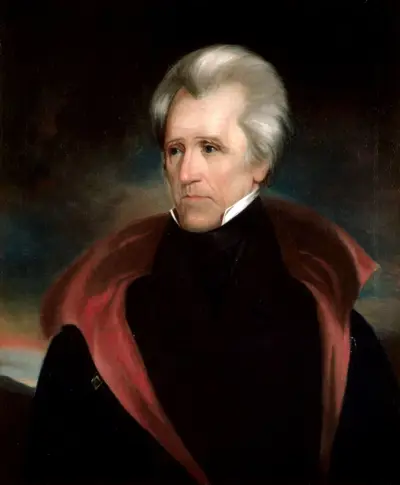
Andrew Jackson was an American lawyer, soldier, and statesman who served as the seventh president of the United States from 1829 to 1837. Before being elected to the presidency, Jackson gained fame as a general in the United States Army and served in both houses of the U.S. Congress. An expansionist president, Jackson sought to advance the rights of the "common man" against a "corrupt aristocracy" and to preserve the Union.
