Ronald Reagan Quotes
Imposing economic sanctions is declaring economic warfare on the people of South Africa.
This was one of the blackest marks on the Reagan Presidency. The Congress had voted sanctions against the racist, dictatorial government of South Africa as many other countries had done. However Reagan opposed the sanctions, although he claimed that he opposed apartheid and the general human rights denial of South Africa, he opposed doing anything about it that might change the situation. To many this was like saying one is opposed to marital rape but refusing to pass legislation to make it illegal. Congress, then passed the sanctions bill overriding the President’s veto.
Ronald Reagan, 1911-2004, 40th President of the United States (Republican, CA), Announcing his intention to veto the Congressional Bill to institute economic sanctions against the tyrannical, apartheid government of South Africa, Message to Congress,1986
Sourced by: Eigen's Political and Historical Quotations

Friedman had handed the President a gift of a Cuban cigar when it was illegal to import products from Cuba as it was U. S. policy not to support the Cuban economy.


The people penalized refers to the American companies who can no longer sell to the sanctioned nation while their foreign competitors do not.

the U. S. and the West Of particular interest is the last sentence. Rarely does the Iranian leader and the American leadership agree on anything, but what Khamenei alleges is exactly the object of American general policy toward Iran. The U. S,, has other objectives as well, and the man purpose of the draconian sanctions is to pressure the Iranians to halt their nuclear weapons development or give the UN access to be sure that there is no military development nuclear program.


At the time there were UN sanctions against Iran for violating the Non Proliferation Treaty regarding transparency of its nuclear development.

Hoover and most Republicans were generally opposed to sanctions and an instrument of foreign policy. 25 years after his presidency, the Republican Party started embracing sanctions as a tool of foreign policy and by the end of the 20th century, Republicans were sanction hawks. This quotation illustrates how American political parties and their philosophies change over time.

All of Europe and the US and the other industrial democracies wanted South Africa to end apartheid and allow majority rule. Many had imposed strong economic sanctions upon the Apartheid nation. Botha, and most of the other Afrikaners, believed that Nelson Mandala and the Blacks were all communists or under the control of the communists, and that ending apartheid would turn South Africa into a Communist Country. Of course that was a paranoid fantasy as all movements for racial or ethnic equality are accused of being communists just as in the American South. When majority rule finally came to South Africa, it showed just how wrong the Afrikaners were as there has been a small communist movement in South Africa which has like the Italian communists functioned but had very little power or influence.


Allen had expressed the concern of the United States that Egypt had purchased Russian arms and was falling into the Russian camp in the Cold War. The United States could not sell arms to Egypt because they wanted to use them to attack Israel.


France and England were at war. Each country seized American ships that were trading with their enemy. Many Americans clamored for war which President Jefferson wished to avoid. He got Congress to pass the Embargo Act which prohibited trading with either of the warring countries. However, some American traders did not obey the law and traded anyway. Napoleon needed money badly so instead of paying the captains of the ships for the goods, he just seized the goods and sold the ships. The U. S. Ambassador to France confronted Napoleon who demonstrated an ability to twist logic and morality that is rare.

The Ayatollah was the Spiritual Leader of Hezbollah, one of the largest terrorist organization in the world at the time. He was even a strong supporter of suicide bombers killing civilians. Unlike many other terrorists, he also supported government economic action.


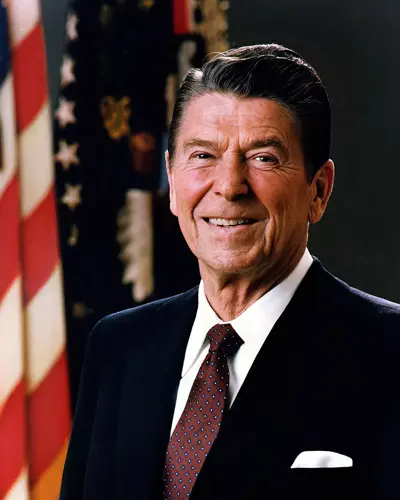
Ronald Wilson Reagan was an American politician who served as the 40th president of the United States from 1981 to 1989 and became a highly influential voice of modern conservatism. Prior to his presidency, he was a Hollywood actor and union leader before serving as the 33rd governor of California from 1967 to 1975.
