Richard Croker Quotes
[Immigrants] are alone, ignorant strangers, a prey to all manner of anarchical and wild notions. Except to their employer they have no value until they get a vote.
Richard Croker, 1841-1922, Tammany Hall Leader, New York City, Quoted by Stead, The London Review of Reviews, October 1897
Sourced by: Eigen's Political and Historical Quotations


Canada’s immigration policies have tended to be more liberal than those of the United States.


This quotation became a very polarizing stimulus in the country with anti-immigration people using it in support of their program to restrict immigration and with liberals and Hispanic groups who saw the quotation as a discriminatory unfounded charge.


The Christian Evangelicals in America have been split on their views of immigration. See {632917} for an example of a contrary position.


Most immigration reformers want to open immigration more widely. Ward wanted immigration restricted to certain ethnicities and limited. Essentially, this was code for anti-Catholicism and anti-Semitism. The immigrants that he described as not being “helpful” have made some of the greatest contributions to America. One element of the immigration debate that is illustrated by this quotation is whether the United State should be homogeneous or heterogeneous. It has been the latter and that has brought the best of cultures of the world to the United States which has constantly been shaped by its immigrants even as it shaped and assimilated the immigrants.


This quotation was a comment on the Donald Trump Ban on Muslim Travel to the US from 7 Islamic countries. Trump, when campaigning for the Presidency, was masterful in appealing to the nativist inclined people of both political parties. He had promised to ban all Muslims from entering the country. When he got elected, he issued an executive order banning Muslims from 7 countries from U.S. entry, There had been a substnatial number of Americans killed by Islamic Terrorists in 9-11 and other acts, and this was the rathional for the Muslim ban. However, of the Americans who had been killed or wounded by Muslim visitors, none of them had been killed by any from the 7 countries that were banned. Thousands had been killed by Islamic terrorists from Saudi Arabia, Egypt and Pakistan, Yet there was no ban on those coutnries. The problem did not exist in the countries that were banned. The Trump motive for this irrational Executive order has never been clear but many thought that he felt he had to look like he was keeping his campaign pledge, and since we did much business with the 3 nations from which the terrorists actually came, while the 7 counties he banned had little or no economic impact on the United States, Some critics ascribed the decision to the fact that Trump personally had substantial business ventures in all of the 3 countries that had produced and on many ways supported the terrorists, but he had no business interests in teh 7 countries upon which he placed the ban. Unlike otehr post 19th century Presidents, Trump refused to divest his ownership of his busineeses, and even refused to place them in a blind trust. A few days after the Executive Order was put into effect, a Federal Judge issues an injuunction to cease enforcing the order until the issue of unConstitutional religious discrimination could be heard. He ruled that there was irreparal harm and the Attorney General of Washinton State who filed the suit was likely to prevail.

Rubenstein, a self-made billionaire from a poor family, not only pledged to give almost all his money away upon his death, but during his lifetime bought manuscripts of the Constitution, the 13the Amendment, the Emancipation Proclamation, the Magna Carta and others and placed them on exhibit in public museums and other public facilities.


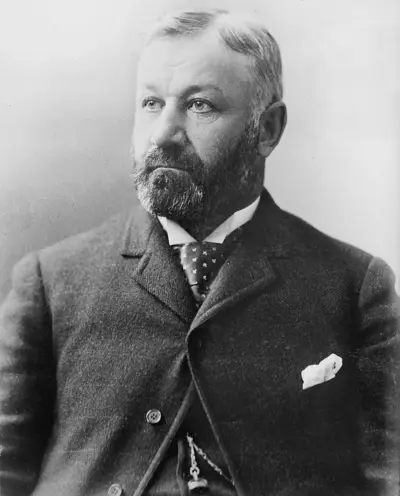
Richard Welstead Croker, known as "Boss Croker," was an American politician who was a leader of New York City's Tammany Hall and a political boss.
