Ron Paul Quotes
If you can’t protect life, then how can you protect liberty?
Paul, Ron. Liberty Defined: 50 Essential Issues That Affect Our Freedom. Grand Central Publishing, 2011.


Note the use of the phrase “against the government.” One of the unique aspects of the American Constitution and The Bill of Rights is that the government is considered a potential and even probable infringer on the liberties of the people. It is almost as though the government was the potential enemy. Modern libertarians state this very explicitly and it is ever present in the views of both the right and left wings of American politics. Most centrists recoil at the thought that some citizens see the government as the enemy, but even in America there have been times where the government has infringed on the rights of citizens only to have the courts or future administrations and Congresses correct the error.

See {587703} for a similar statement by a Supreme Court Justice.


Hayward claimed that Wilson was the first American President who ever criticized the American Constitution. Many do not agree as Madison and Jefferson in part, along with most other Americans, found the Constitution so wanting that it was ratified only on condition of the passage of the Bill of Rights. Jackson, was distressed by the limitations on the President and many others had their objections, but Wilson, before he became a politician was a prominent academic political scientist and wrote voluminously and had an intellectual following so his criticism was not considered so “political” as others.


The people who raise the issue do not claim that property rights are not human rights. They do analyze different rights to priorities. For example, most people would view the right to life as more important than the right to travel. Unfortunately rights sometimes come into conflict. What Rand calls the “dichotomy” is the prioritizing of property fights as lower than some other rights such as the right to life. Those people would argue that a businessman should not have a facility that is a public hazard and interfere with his property rights to protect the lives of the public who might encounter the hazard.


Ingersoll was considered to be the greatest orator and political thinker of his day, but his overt atheistic views curtailed his elected political career.


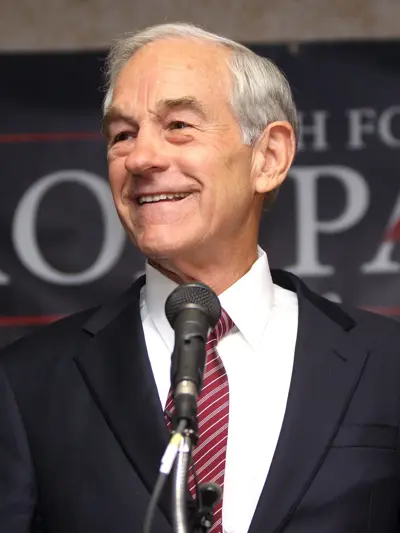
Ronald Ernest Paul is an American author, physician, and retired politician who served as the U.S. Representative for Texas's 22nd congressional district from 1976 to 1977 and again from 1979 to 1985, and for Texas's 14th congressional district from 1997 to 2013. On three occasions, he sought the presidency of the United States: as the Libertarian Party nominee in 1988 and as a candidate for the Republican Party in 2008 and 2012. A self-described constitutionalist, Paul is a critic of the federal government's fiscal policies, especially the existence of the Federal Reserve and the tax policy, as well as the military–industrial complex, the war on drugs, and the war on terror. He has also been a vocal critic of mass surveillance policies such as the USA PATRIOT Act and the NSA surveillance programs. He was the first chairman of the conservative PAC Citizens for a Sound Economy, a free-market group focused on limited government, and has been characterized as the "intellectual godfather" of the Tea Party movement, a fiscally conservative political movement that is largely against most matters of interventionism.
