Mahatma Gandhi Quotes
If we all discharge our duties, rights will not be far to seek.
Gandhi, Mahatma. Young India, 8 Jan. 1925, p. 15. Reprinted in The Collected Works of Mahatma Gandhi, Vol. 25, Publications Division, Ministry of Information and Broadcasting, Government of India, 1967.


The Illuminati was a secret society. At the time, anyone who differed with the Church on issues of philosophy, ethics or religion could be tortured and burned at the stake, and anyone who criticized the Monarchy could be tortured and hung or beheaded. The result was the concept of a secret society of which the Illuminati was one.

Note that the two do NOT ALWAYS coincide. There are those who argue that law should be respected, right or wrong. There are also those who argue that law should be respected, only when it is in the right. Note also that “respect” and “obedience” are two different things. Some people argue that law and the courts and government must have respect. Others that they are only due obedience but not necessarily respect when they are in the wrong. Still others, like Thoreau, that obedience even is not required when the law is wrong. There are those who take this to the degree that obedience to a “wrong” law is wrong and there is a DUTY to disobey a wrong law. However, a more nuanced view does not treat all laws as the same importance. I may think a particular tax is unjust and wrong, but obedience does not necessarily have moral consequences. A law that says that people with a certain religion must not be hired, however, is sufficiently immoral that I am obliged to disobey it.


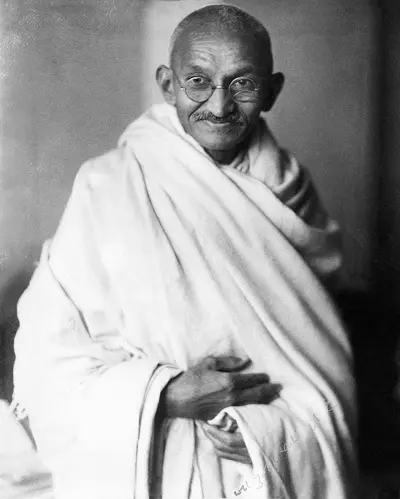
Mohandas Karamchand Gandhi was an Indian lawyer, anti-colonial nationalist, and political ethicist, who employed nonviolent resistance to lead the successful campaign for India's independence from British rule, and in turn inspired movements for civil rights and freedom across the world. The honorific Mahātmā (Sanskrit: "great-souled", "venerable"), first applied to him in 1914 in South Africa, is now used throughout the world.
