George Berkeley Quotes
If we admit a thing so extraordinary as the creation of this world, it should seem that we admit something strange, and odd, and new to human apprehension, beyond any other miracle whatsoever.
Berkeley, George. Three Dialogues Between Hylas and Philonous. Henry Clements, 1713, Third Dialogue.


There are many scientists who disagree with Johnson’s very unusual logic. They point out that it is certainly possible that God initially did not have had humans in minds, and when they evolved, decided that they were worthy of salvation history and then interfered to the extent of a virgin birth. Others would point out that just because man cannot exactly foresee the exact future pattern of evolution, does not men that a Supreme Being could not have initiated the mechanism that he/she knew would result in salvation history. The Pope and the Catholic Church see no inconsistency between Darwinism and the salvation history. Then there are those non-Christians who do not believe that God ever did introduce salvation and there are many more of them than there are Christians. Then, it is possible that God just set things in motion and had more important things then micromanaging evolution on our one planet in a universe of billions of billions. Last there are those who do not believe that there is or has been a God. Of course there is the possibility that Johnson is right, and religiously he may be, but that is not subject to scientific analysis.

Watchtower Bible and Tract Society of New York

His concept of the devine however was quite different and much more abstract than the Rabbis, Priests and Imams of the time. Albert Einstein, was a religious Jew, but his view of God was that of Spinoza (See Quotation 631763) who had been excommunicated by the Jews. Spinoza’s ideas were considered so radical and dangerous that he was the only man in history who was excommunicated by the Catholics, the Jews and the Muslims. Spinoza did not believe in a kins of anthropromorphic God who fabricated the earth and the stars. He saw God in the devine nature of the earth and the heavens and the mathematical rules that govern everything. It was this abstraction that was Spinoza's God which made sense to Einstein. Got was in the order, physical laws and mathematics of the universe. Modern scientists who are religious have no difficulty with the probablsitic nature of much of the physics that governs the univrese. It was God who created or more abstractly, was the mathematical and physical laws that in turn allowed the universe to be created from nothing.


The religious theology of the Church of England had accepted the fact based on Newton’s work, that the heavenly bodies followed a set of scientific laws that were themselves created by God. However, the Church could not accept the same principle when it came to the different species of humans and lower order animals. Each species they believe was created with all its characteristics by God directly and species could not change, develop, regress, go extinct unless God specifically ordained that. It was this inconsistency that Darwin was afraid would produce religious attacks on him and his notions of natural selection while astronomy and physics was treated very different theologically. Darwin delayed publishing his findings for 25 years hoping to find a religious atmosphere that would treat biology much as physics and astronomy. It didn’t come and finally he published and took the heat, which actually was not very great. With the exception of some religious fundamentalists, most other elements of society welcomed and supported Darwin’s ideas which today we realize were among the most important ever put forth in the world of science.
This quotation is important and memorable for several reasons. First, the Congressman is one of the relatively few highly educated Americans who believe in the literal interpretation of the Bible. Most Christians and Jews do not interpret the ancient scripture literally. Most Christian and Jewish religious organizations, including the Roman Catholic Church, have no problem at all with evolution and the big bang theory. As a matter of fact, the scientist who developed the mathematics to explain the big bang was a Catholic Priest. Even some religious people who do not believe that that evolution is not an accurate interpretation, rarely claim that the Earth is only 9,000 years old. It is actually over 13 Billion years old. An anti-scientific view of the world is certainly within an American’s right, but the fact that this congressman was assigned by The Republican Party leadership to be a Member of the House Committee on Science, Space and Technology given his belief structure is amazing, If the earth were only 9,000 years old, there is no way the global positioning satellites could tell us where we are, our nuclear arsenal would be unstable and dangerous, radiation medicine would not help anyone get well just for a few examples. A second noteworthy aspect is that the Congressman is not just stating that the millions of scientists and science teachers are wrong—in error. He accuses each and every one of them of acting as agents of Satan and that their motivation in studying and doing science is to undermine his and others faith in God and that none of them has any belief in or desire for a personal Savior. It is rare that this type of un-American behavior is found in a member of Congress who claims that any person who disagrees with his religions views or has different Biblical interpretations is an agent from Hell. The founding fathers created the First Amendment to cope with and even tolerate the few who had the extreme and unrealistic views of this Congressmen.


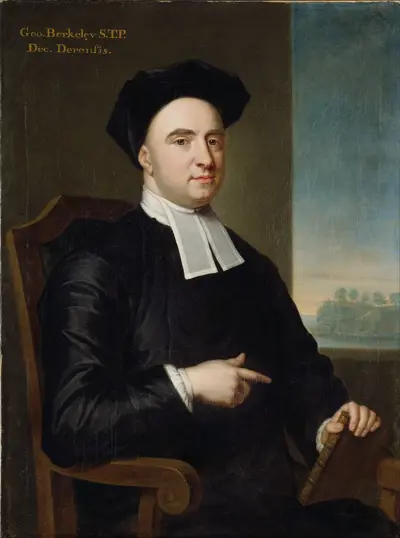
George Berkeley – known as Bishop Berkeley (Bishop of Cloyne of the Anglican Church of Ireland) – was an Anglo-Irish philosopher whose primary achievement was the advancement of a theory he called "immaterialism" (later referred to as "subjective idealism" by others). This theory denies the existence of material substance and instead contends that familiar objects like tables and chairs are ideas perceived by the minds and, as a result, cannot exist without being perceived. Berkeley is also known for his critique of abstraction, an important premise in his argument for immaterialism.
