Thomas A. Edison Quotes
If the Nation can issue a dollar bond it can issue a dollar bill. The element that makes the bond good makes the bill good also. The difference between the bond and the bill is that the bond lets the money broker collect twice the amount of the bond and an additional 20%. Whereas the currency, the honest sort provided by the Constitution pays nobody but those who contribute in some useful way. It is absurd to say our Country can issue bonds and cannot issue currency. Both are promises to pay, but one fattens the usurer and the other helps the People.
Edison, Thomas A. Interview. The New York Times, 6 Dec. 1921, p. 17.


This frequent Jefferson quotation almost certainly was never written or uttered by him but was probably created by later opponents of private banks. It has never been verified from any studies of Jefferson’s prolific writings. Further the word ‘inflation” came into use in the 1860s and ‘deflation’ seems to have first been used in the 1920s. However, some ascribe it to a letter Jefferson wrote to Treasury Secretary, Albert Gallatin in 1802.

At the time, there was no United States currency. Private banks in some of the states issued their own money. A dollar from Georgia might only be worth 75 cents in New York.


The Hoover administration had lost control of the economy. The nation was in a depression. Banks were failing. Gold was being hoarded and taken out of circulation while we were on the gold standard. Roosevelt’s solution was to decouple American money and gold—a solution that William Jennings Bryan had suggested many years earlier. See {640978}.

At the time, a bank note—paper money issued be a private bank—was not backed by any gold or silver and was not insured bym the government. A bank could print as much as they wanted, so it was always worth less as the further you were from the particular issuing bank, the less you could get your bank note, because no one knew whether or not the issuing bank would redeem the note or even be in existence. So every private bank note had diminished value for the public. However, carrying gold and silver around and making change for precious metals was difficult and often impractical. So people used banknotes. The same thing happens with credit cards today. The merchant has to pay a fee to the credit card company and the bank and therefore charges us more for whatever we buy. But most consumers and merchants are willing to pay the difference to obtain the convenience of the credit card,

The last sentence echoes a quotation of Napoleon. See {630664} .


By the time the debt ceiling needs a Congressional vote, the money has already been obligated and spent. That is when Congress can control spending. The debt ceiling is ALWAYS increased by Congress when asked otherwise the U. S. would not be able to pay its bills. However, many members of Congress like the fact that every year or so the administration needs their votes so they can extract benefits for their constituents more easily with that leverage.

This was a take-off on Vice President Marshall’s slogan: {606496}

He was against paper money. At the time, any bank could issue its own paper money or “banknotes”. However other banks would not redeem the banknotes for the full amount; they would “discount” the note. Usually, the further away the bank was from the original bank, the more discount they took. Interstate commerce was almost impossible. Alexander Hamilton, Jefferson’s nemesis, had a much more modern point of view and fortunately his view prevailed. Paper money could only work if it was issued by a central bank with no discounting by other banks. The paper money had to be “legal tender”.


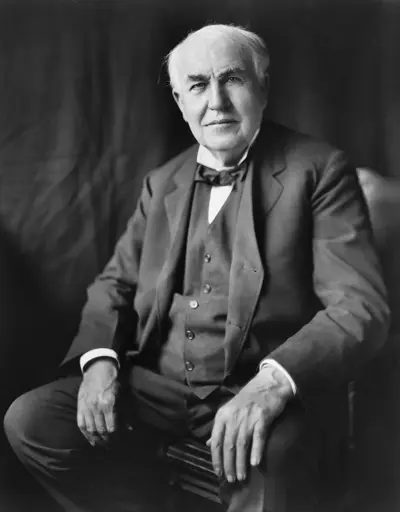
Thomas Alva Edison was an American inventor and businessman who has been described as America's greatest inventor. He developed many devices in fields such as electric power generation, mass communication, sound recording, and motion pictures. These inventions, which include the phonograph, the motion picture camera, and early versions of the electric light bulb, have had a widespread impact on the modern industrialized world. He was one of the first inventors to apply the principles of organized science and teamwork to the process of invention, working with many researchers and employees. He established the first industrial research laboratory.
