Martin Luther Quotes
If the gospel was of a nature to be propagated or maintained by the power of the world, God would not have intrusted it to fishermen. To defend the gospel appertains not to the princes and pontiffs of this world.
d'Aubigné, J. H. Merle. History of the Reformation of the Sixteenth Century, Vol. 3. Robert Carter & Brothers, 1848, p. 19.


Pippin had the opportunity of expanding his empire by conquering the Lombards whose cavalry he could use if and when the Saracen Muslims would invade again. But he would be seizing another Christian country, contrary to the Pope’s edicts, thus losing the blessings of the Pope. Hence the question. He decided to go for the cavalry. Later, Joseph Stalin asked the same question in much different context. See {627524}. Some historians question whether Pippen actually uttered the quotation or just considered it.

There was a continuing power struggle between the more powerful kings of Europe and the Roman Catholic Pope. This struggle however was not one of church and state. Neither the kings nor the clergy viewed the two as separate domains. Instead they saw the two in much the same way as the ancient Jews and many contemporary Muslims view relationship—as an inseparable amalgam. However there was much debate over who could best protect and manage the amalgamated entity. In this case Alcuin was arguing that Charlemagne could ensure the well-being of the church better than the Pope. The power struggle went on for centuries between more or less able, powerful, and corrupt kings and popes.
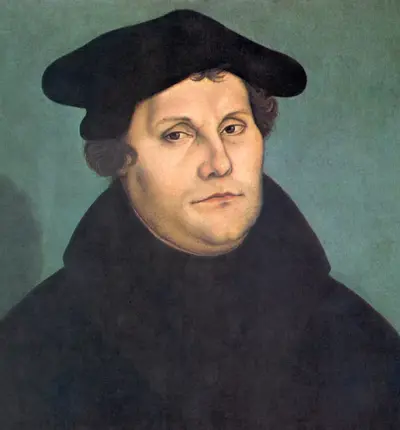
Martin Luther, O.S.A. was a German professor of theology, priest, author, composer, Augustinian monk, and a seminal figure in the Reformation. Luther was ordained to the priesthood in 1507. He came to reject several teachings and practices of the Roman Catholic Church; in particular, he disputed the view on indulgences. Luther proposed an academic discussion of the practice and efficacy of indulgences in his Ninety-five Theses of 1517. His refusal to renounce all of his writings at the demand of Pope Leo X in 1520 and the Holy Roman Emperor Charles V at the Diet of Worms in 1521 resulted in his excommunication by the pope and condemnation as an outlaw by the Holy Roman Emperor.
