John Dickinson Quotes
If the General Government should be left dependent on the State Legislatures, it would be happy for us if we had never met in this room.
Farrand, Max, editor. The Records of the Federal Convention of 1787. Vol. 1, Yale University Press, 1911, p. 87.


Mason’s view prevailed. What is interesting is that Mason saw the State as the State Legislature as opposed to the people of the state directly voting for the Senators as we do today.


Martin and other anti-Federalists argued against ratifying the new Constitution as they thought that it was inimical to the state’s interest. The notion of Federalism as a danger to states is clearly stated in this quotation for the debate on Constitutional ratification. Fundamentally, are Senators representatives of their states or of the Federal Government. If the former, who can the senators be recalled or impeached by the states to who the presumably owe their loyalty? This issue, like so many others, was compromised. The States would control the selection and method of selection of the Senators but could not recall or impeach. Looking back, we see this as logically inconsistent. However, looking at it as a political compromise between two legitimate points of view, it seems quite reasonable. Early America was a combination of idealism and pragmatism which has carried throughout American history.

On June 12, 1789 a Senate committee proposed a federal court system for the nation. Maclay described it as:
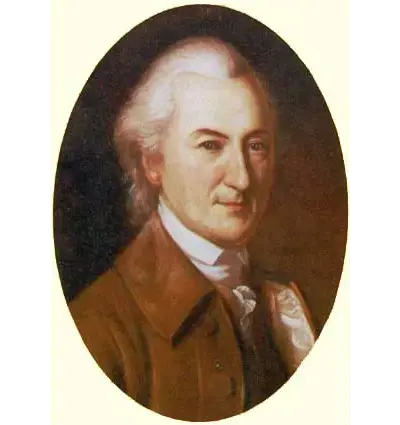
John Dickinson, a Founding Father of the United States, was a solicitor and politician from Philadelphia, Pennsylvania, and Wilmington, Delaware, known as the "Penman of the Revolution" for his twelve Letters from a Farmer in Pennsylvania, published individually in 1767 and 1768. As a member of the First Continental Congress, where he was a signee to the Continental Association, Dickinson drafted most of the 1774 Petition to the King, and then, as a member of the Second Continental Congress, wrote the 1775 Olive Branch Petition. When these two attempts to negotiate with King George III of Great Britain failed, Dickinson reworked Thomas Jefferson's language and wrote the final draft of the 1775 Declaration of the Causes and Necessity of Taking Up Arms. When Congress then decided to seek independence from Great Britain, Dickinson served on the committee that wrote the Model Treaty, and then wrote the first draft of the 1776–1777 Articles of Confederation and Perpetual Union.
