Isambard K. Brunel Quotes
If the Commission is to enquire into the conditions "to be observed," it is to be presumed that they will give the result of their enquiries; or, in other words, that they will lay down, or at least suggest, "rules" and "conditions to be (hereafter) observed" in the construction of bridges, or, in other words, embarrass and shackle the progress of improvement to-morrow by recording and registering as law the prejudices or errors of to-day. [Objecting to any interference by the State with the freedom of civil engineers in the conduct of their professional work.]
Brunel, Isambard. The Life of Isambard Kingdom Brunel, Civil Engineer. Longmans, Green, and Co., 1870, p. 195.


La Guardia was the foe of pork-barrel politics:


Mittleberger wrote a treatise warning his countrymen of the problems in Pennsylvania where many German youth were coming as indentured servants and apprentices.


Mises observes the classic philosophical quandary of business and commerce. If we cannot leave everything to the market place and the capitalists and entrepreneurs because they are morally and ethically fallible, will not the government people who regulate and control them be equally moral and fallible? Mises critics point out that Mises misses the difference in a democracy, that if fallible businessmen err, all can suffer and their personal vested interests do not necessarily coincide with the interests of the majority in general. If the government representative of the majority are fallible and err, the majority can correct them and if the majority does not, the people have undone themselves and have not been the victims of the foibles of a few privileged people in the society. Mises argues that it is the minority who, if left alone, would produce the best standard of living for the majority who should exercise they right to regulation only by their acts as consumers.
The Grammar Curmudgeon
This practice to try and derail bills they objected to emanated from the hyperpartisanship of the time. The conservative base of voters so opposed the legislation that they would not punish and not vote for a member of Congress for deliberately lying as long as the lies contributed to the conservative political ideology. Some of the members had this as a justification for lying in this way: “These provisions are exactly what the Democrats would add as an amendment or by regulations if they could. It is important that the voters know that they will do if the legislation passes and realize that they people who support this terrible legislation really desire to socialize the American Economy.” Often, they would base their judgment about what the Democrats wanted by taking a single statement made by someone at the extreme left and claim that that was Democratic party thinking. The tactic worked in a number of cases, but not with Dodd-Frank which passed despite a Republican filibuster in the Senate. Some of the extreme liberals in Congress then started to use the techniques in the House of Representatives where they were in the minority.

In bureaucracy, as in most other aspects of politics, it is not a serious problem if you are wrong as long as most or many others are. However, if your are alone, you had better be right.

When the Meltdown hit America, the crisis drew attention to the fiscal solvency and stability of banks in most of the world. The Irish banks were much more overextended than those of most counties and when that came to light there was a bank panic in Ireland. Ahern and the Irish Dail (parliament) decided to bail out the Irish bank at a very great cost to the rest of the Irish economy and people. He believed if Lehman Brothers had been bailed out, as America did with other institutions, the Irish bank bubble would not have burst. It is not known whether he actually meant to use the word “testicles” or he made a gaff intending to use the word “tentacles”. Both have relevant meaning in the situation with a significant shade of difference in meaning between the two.


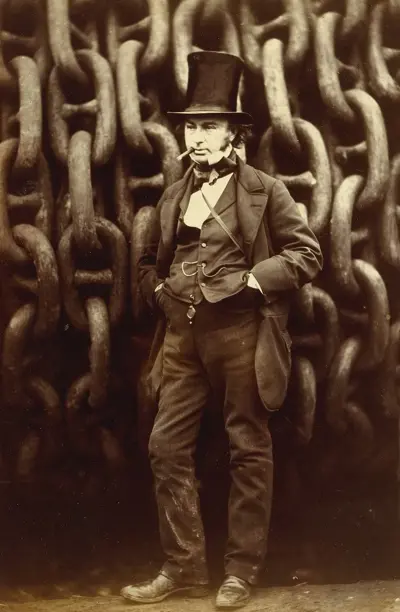
Isambard Kingdom Brunel FRS was an English civil engineer who is considered "one of the most ingenious and prolific figures in engineering history," "one of the 19th-century engineering giants," and "one of the greatest figures of the Industrial Revolution, [who] changed the face of the English landscape with his groundbreaking designs and ingenious constructions." Brunel built dockyards, the Great Western Railway (GWR), a series of steamships including the first propeller-driven transatlantic steamship, and numerous important bridges and tunnels. His designs revolutionised public transport and modern engineering.
