Lee Kuan Yew Quotes
If it is not totalitarian to arrest a man and detain him, when you cannot charge him with any offence against any written law – if that is not what we have always cried out against in Fascist states – then what is it?… If we are to survive as a free democracy, then we must be prepared, in principle, to concede to our enemies – even those who do not subscribe to our views – as much constitutional rights as you concede yourself.
Lee, Kuan Yew. Legislative Assembly Debates Singapore: Official Report. Legislative Assembly of Singapore, 21 Sept. 1955.


Even in the United States, there have been occasions where this has happened such as the Japanese American internment in WWII, and the George W. Bush Administrations actions in fighting the War on Terror. Yew was in opposition at the time he made this famous statement. 30 years later when he was the Prime Minister, he had a different view. See {585201}.


Note the use of the phrase “against the government.” One of the unique aspects of the American Constitution and The Bill of Rights is that the government is considered a potential and even probable infringer on the liberties of the people. It is almost as though the government was the potential enemy. Modern libertarians state this very explicitly and it is ever present in the views of both the right and left wings of American politics. Most centrists recoil at the thought that some citizens see the government as the enemy, but even in America there have been times where the government has infringed on the rights of citizens only to have the courts or future administrations and Congresses correct the error.
Note the use of the phrase “against the government.” One of the unique aspects of the American Constitution and The Bill of Rights is that the government is considered a potential and even probable infringer on the liberties of the people. It is almost as though the government was the potential enemy. Modern libertarians state this very explicitly and it is ever present in the views of both the right and left wings of American politics. Most centrists recoil at the thought that some citizens see the government as the enemy, but even in America there have been times where the government has infringed on the rights of citizens only to have the courts or future administrations and Congresses correct the error.

This is probably the first known use of the Bill of Rights phrase in the English language. For the earliest American use, see Edward Rutledge.


Mosley had been incarcerated without charges or trial under the “national emergency” of the Second World War. This prevented him from organizing his “Blackshirts.” When it was clear that Germany would lose the war, Oswald was released, but without the prospect of Fascism dominating continental Europe, there was little interest in Fascist movements in England.


Many New Yorkers and others felt that since the attack on the World Trade Center was made in the name of Islam, the mosque and commuity center should be built in another location further from Ground Zero. Ellison was debating someone who argued that the Mosque should not be built so that sensitivity can be shown for those New Yorkers who lost relatives and friends in the attack of September 11. Rather than insist on their Constitutional rights, the Muslim leadership of the project, moved the location somewhat further away from Ground Zero.

In the aftermath of 9-11, a few government agencies violated the law and civil rights of a number of “Muslims” and/or “Middle Eastern looking” individuals and held them incommunicado with no charges and no warrants. The rationale of those agencies is that they “could not take a chance as lives were at stake. In most major wars in America, there has been an “overreaction” by some officials.


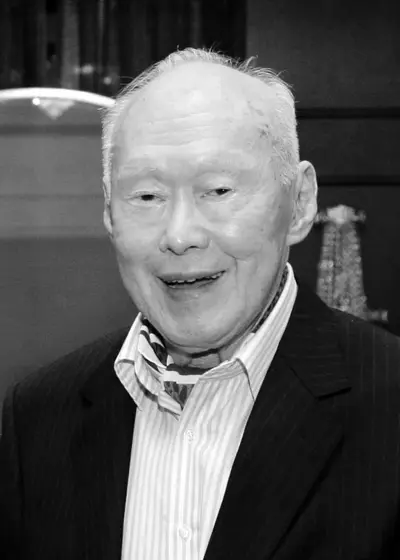
Lee Kuan Yew GCMG CH SPMJ, often referred to by his initials LKY, was a Singaporean statesman and lawyer who served as Prime Minister of Singapore from 1959 to 1990. As one of the founding members of the People's Action Party, Lee is recognised as the nation's founding father, credited with rapidly transitioning the country from a "developing third world country into a developed first world country within a single generation" under his leadership. Lee died of pneumonia on 23 March 2015, aged 91. In a week of national mourning, about 1.7 million Singaporean residents as well as world leaders paid tribute to him at his lying-in-state at Singapore's Parliament House and at community tribute sites around the country.
