Roger Bacon Quotes
[I]f in other sciences we should arrive at certainty without doubt and truth without error, it behooves us to place the foundations of knowledge in mathematics, in so far as disposed through it we are able to reach certainty in other sciences and truth by the exclusion of error.
Bacon, Roger. The Opus Majus of Roger Bacon. Translated by Robert Belle Burke, vol. 1, University of Pennsylvania Press, 1928, p. 119.


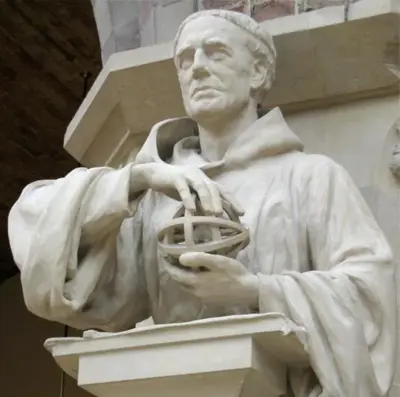
Roger Bacon (/ˈbeɪkən/; Latin: Rogerus or Rogerius Baconus, Baconis, also Frater Rogerus; c. 1219/20 – c. 1292), also known by the scholastic accolade Doctor Mirabilis, was a medieval English philosopher and Franciscan friar who placed considerable emphasis on the study of nature through empiricism. In the early modern era, he was regarded as a wizard and particularly famed for the story of his mechanical or necromantic brazen head. He is sometimes credited (mainly since the 19th century) as one of the earliest European advocates of the modern scientific method. Bacon applied the empirical method of Ibn al-Haytham (Alhazen) to observations in texts attributed to Aristotle. Bacon discovered the importance of empirical testing when the results he obtained were different than those that would have been predicted by Aristotle.
