Richard P. Feynman Quotes
If I could explain it to the average person, I wouldn't have been worth the Nobel Prize.
Richard P. Feynman, 1918-1988, Nobel Laureate in Physics, Member, Commission investigating the Challenger accident, Response to an interviewer to describe for the layman his Nobel Winning Experiments, People, July 22, 1985
Sourced by: Eigen's Political and Historical Quotations


Scientific breakthroughs depend on genius, circumstances, the work of others and serendipity. None of these are very predictable which is why it is do difficult to manage a scientific enterprise and be accountable for any results. See {624867}.

The problem effects politics in that politicians and their staffs who have to understand critical concepts cannot even read up on the subject very deeply unless they have experience with the technical vocabulary of the specific field. The result is that are dependent on experts and are unable to reach conclusions for themselves.

Bethe was the head of the Theoretical Division of Los Alamos and was one of the Senior Scientists who developed the Atomic Bomb.

This quotation was a milestone on scientific and technological development. For the first time in human history the smartest and most creative and visionary people, could not understand or comprehend the direction in which science and technology was moving. It now took people with specialized mathematical capability. Experience and intuitive insight was actually counter-productive in understanding the world as it was being revealed. Intelligence, creativity, perseverance and hard work, for the first time was insufficient. Education and training was the new requirement in addition to the others.

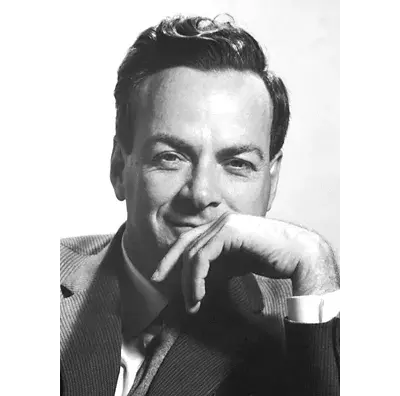
Richard Phillips Feynman was an American theoretical physicist and Nobel Prize winner who made significant contributions to quantum mechanics, quantum electrodynamics, and particle physics. He's known for his work on the Manhattan Project, developing Feynman diagrams, and explaining the interactions between light and matter. While studying for his PhD, Feynman participated in the Manhattan Project and helped develop the atomic bomb. For contributions to the development of quantum electrodynamics, Feynman received the Nobel Prize in Physics in 1965 jointly with Julian Schwinger and Shin'ichirō Tomonaga.
