John F. Kennedy Quotes
If anyone is crazy enough to want to kill a president of the United States, he can do it. All he must be prepared to do is give his life for the president's.
John F. Kennedy, 1917-1963, 35th President of the United States (Democrat, MA), Quoted in Pierre Salinger, With Kennedy, Doubleday, 1966
Sourced by: Eigen's Political and Historical Quotations


He did indeed kill the Bank of the United States by exercising the Presidential Veto on the legislation renewing the Bank’s government charter. The Bank was privately owned but handled all the fiscal functions for the Government and holding the United States deposits. The Bank owners and executives were not supports of Jackson and opposed him on many issues. Jackson thought it outrageous that a private bank, not under the control of the people or the representatives of the people, should have a monopoly on the banking functions of the United States. Vetoes were very unusual then. All the presidents before Jackson together vetoed only 12 laws. Jackson himself vetoed 13 including the Bank of America.

Joking about the "incompetence" of Vice President Dan Quayle. Kerry later apologized for the joke.


Some considered the doctor a quack. Almost all medical authorities agree that the combinations of drugs that Kennedy was given was dangerous and irresponsible for any physician to prescribe. But they worked well enough in the short term to meet the president’s need to be able to go through with the summit meeting. However, Kennedy did very poorly and was bested badly by Khrushchev. Whether is physical condition had any effect on JFK’s poor performance has never been determined.


Pinkerton worked out a plan to spirit Lincoln through Baltimore where he had to change trains.


An assassin had tried to kill the archduke and failed. In response to the complaints the mayor changed the archduke’s route the following day when he was successfully assassinated provoking World War I.

President Obama had publicly drawn a line in the sand stating the Syrian government must not use chemical weapons to put down the revolution and they went ahead and did it anyway. They did turn over all their chemical weapons to coalition forces, but Obama did not order any military or serious economic retribution for having dared to cross the line. The President argued that now that there were no chemical weapons in the hands of the government, the problem was solved. Many, including Gates, thought that this was a big mistake because American foreign policy and military prestige was at stake—that future presidents had diminished credibility because the United States might or might not follow through with their threats. See {642572} for a similar criticism.

In England, the King was above the law. However, impeachment was a tool that could be used against his favorite ministers. In debating the United State Constitution one of the first questions to be determined was whether impeachment could be a tool used against the President or like, England, only the other government officials. Franklin urged the President be included. See also Mason: {584246}.


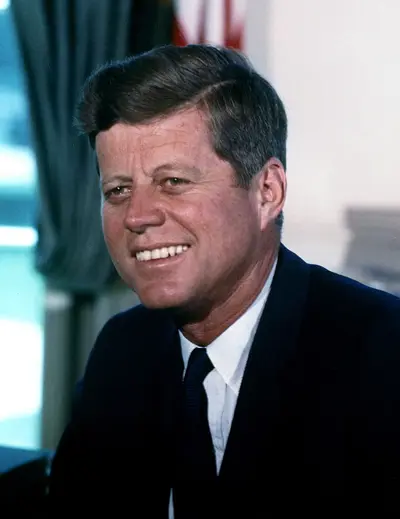
John Fitzgerald Kennedy, often referred to by his initials JFK, was an American politician who served as the 35th president of the United States from 1961 until his assassination in 1963. Kennedy served at the height of the Cold War, and the majority of his work as president concerned relations with the Soviet Union and Cuba. A Democrat, Kennedy represented Massachusetts in both houses of the U.S. Congress prior to becoming president.
