Victor Hugo Quotes
If a man has his throat cut in Paris, it's a murder. If 50,000 people are murdered in the east, it is a question.
Hugo, Victor. "Pour la Serbie." Actes et Paroles, vol. 4, Calmann Lévy, 1889, p. 302.

Commenting on U. S. policy on Bosnia:


Wherever there has been a true free press, there have been anti-war activists who are particularly critical of the affect on civilians—collateral damage or otherwise.


The Armenian-Turkish enmity was vicious to the point that each people tried to kill and exterminate the other—men women and children. The atrocities committed by the Armenians were unfortunately greatly exceeded by the Turks in what is now often referred to as the “Armenian Genocide”—see {51838}, {631062} and {61904}. Armenians were in the minority yet each side slaughtered members of the other whenever they could. The Ottoman Turks were much better at it. The hatred still prevails – see {588211}. And Turks and Armenians both still accuse the other of atrocities during the period and appear in denial about their own violence.

The soldiers obeyed their orders and killed every man, woman and child they could find outside the city. They beheaded captured prisoners, bayoneted pregnant women and children. All civilian houses were burned, often with the people trapped inside.

This statement caused great consternation. NcNutt did try to explain that he was speaking personally and not for the Government, but there was a small proportion of America who had concluded that all Japanese should be killed. Such an concept which was unthinkable 5 years earlier was considered as a result of several factors: The Japanese had murdered many American prisoners of war. Killed millions of civilians throughout Asia including doing medical and weapons experiments on live human beings. They had practiced torture, compulsory prostitution and mass rape of conquered territories. At the same time, the Germans had tried to exterminate all the Jews and, with some Japanese help, did kill two-thirds. The concept of genocide had been introduced to Americans as the concentration camps were liberated. And American casualties in the Pacific had been heavy. Vengeance was desired by many. Fortunately, the overwhelming majority of Americans never considered genocide seriously.


This is the origin of the term “democide” which while not yet in common use has an importantly different meaning from genocide. The former Soviet Union killed millions for the purpose of gaining and maintaining power although they were not intending to wipe our a people or a culture—just opponents. Nazi Germany was guilty of both genocide and democide.


Saloth Sar Pol Pot. He was responsible for the brutal killing of over 1 million of his own people.

There had been a Ukrainian coup where the pro-Russian President of Ukraine was ousted and a new Parliament elected that was more inclined to Europe and the West. Unfortunately, several of the key members of the new regime were neo-Nazis. Ukraine had a nasty past where during WWII over 200.000 Ukrainians joined Hitler’s Nazis and fought against the 800,000 Ukrainians fighting with Russia and the Russians. The Ukrainians even ran the only death concentration camp no operated by Germans. Russia used the presence of some Nazis and the passage of the first Ukranian law of the new Parliament that prohibited the use of Russian in Ukrainian schools to come to the “aid” of the ethnic Russians living near the Russian border at the Eastern end of Ukraine who had seized the governments of several areas and forced the Ukrainian officials out and with the help of Russian “volunteers” with Russian weapons, prevented Ukrainian troops from reasserting control. In the struggle there were deaths on both sides of the conflict and these were the “peaceful civilians” who were “annihilated”.


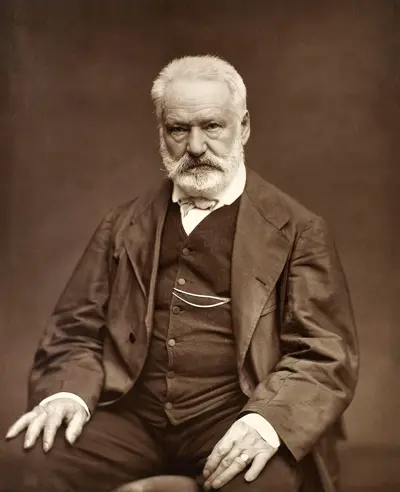
Victor-Marie Hugo was a French poet, novelist, and dramatist of the Romantic movement. During a literary career that spanned more than sixty years, he wrote abundantly in an exceptional variety of genres: lyrics, satires, epics, philosophical poems, epigrams, novels, history, critical essays, political speeches, funeral orations, diaries, letters public and private, as well as dramas in verse and prose.
