Homer Quotes
I would rather be a serf in a poor man's house and be above ground than reign among the dead.
Homer. The Odyssey. Translated by E. V. Rieu, Penguin Books, 1946, p. 184.

Criticizing restrictive health care policies regarding organ transplantation:


Soon after, he led 960 men, women and children in a mass suicide at Masada.


This leading “conductor” of the Underground Railroad carried a loaded pistol which she brandished if escaping slaves would get discouraged and not follow instructions endangering the others or the organization itself. The Underground Railroad referred to the clandestine method that Tubman and other “conductors” would risk their own lives by going down South and guiding escaped slaves through a series of safe houses and locations “stations” until they reached Canada where slaves could not be legally recaptured.

This fascinating quotation is very frequently quoted out of context. For example even in modern times some Southern slavery apologists quote this passage stating that Adams saw no moral difference between slavery and employment of the lower classes. And anti-capitalists have claimed that this was an attack on capitalism as no better than slavery for many workers. Neither is true. The debate was on the head taxes that states should pay to the central government. Southerners were claiming that they should not have to pay per person taxes on slaves. Adams position was that they should pay in that there is no practical difference in the work and working conditions very often. If slaves should be exempted from the head tax, so should the poor, lower class workers like the fisherman in New England. He always maintained at huge moral difference between a poor free worker and a slave even thought their working conditions might be similar.

He, like so many Americans were shocked at the statistics on the relationship between earnings and infant mortality which does not exist in other industrial democracies.


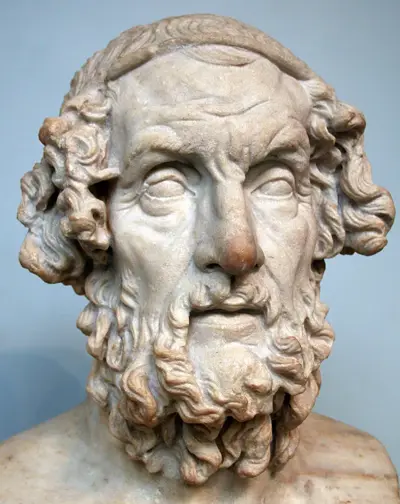
Homer (/ˈhoʊmər/; Ancient Greek: Ὅμηρος [hómɛːros], Hómēros) was the presumed author of the Iliad and the Odyssey, two epic poems that are the foundational works of ancient Greek literature. The Iliad is set during the Trojan War, the ten-year siege of the city of Troy by a coalition of Greek kingdoms. It focuses on a quarrel between King Agamemnon and the warrior Achilles lasting a few weeks during the last year of the war. The Odyssey focuses on the ten-year journey home of Odysseus, king of Ithaca, after the fall of Troy. Many accounts of Homer's life circulated in classical antiquity, the most widespread being that he was a blind bard from Ionia, a region of central coastal Anatolia in present-day Turkey. Modern scholars consider these accounts legendary.
