Siegfried Sassoon Quotes
I wish I could believe that Ancient War History justifies the indefinite prolongation of this war. The Jingos define it as 'an enormous quarrel between incompatible spirits and destinies, in which one or the other must succumb'. But the men who write these manifestos do not truly know what useless suffering the war inflicts...And the Army is dumb. The Army goes on with its bitter tasks. The ruling classes do all the talking. And their words convince no one but the crowds who are their dupes. The soldiers who return home seem stunned by the things they have endured...If only they would speak out and throw their medals in the faces of their masters; and ask their women why it thrills them to know that they, the dauntless warriors, have shed the blood of Germans.
Siegfried Sassoon, 1886-1967, English Poet & Soldier, Diary, June 19 1917
Sourced by: Eigen's Political and Historical Quotations


There was a Sedition law which made it a Federal felony to encourage anyone not to join or support the military during the First World War. The Socialist Politician and Candidate for President, Eugene Debbs and others, were jailed for less seditious statements. Helen Keller was a remarkable woman who was blind and deaf, and yet she became a great orator and social reformer. The administration died not relish the reaction if they put this popular, blind, deaf woman in jail so she was never charged. The law of course was unconstitutional, but it took years to reach that determination. Until then, the Sedition Act was one of the worst examples of infringement in American history since the original Alien and Sedition Acts of John Adams.


Ataturk was a young major at the time commanding troops of a weak and corrupt Ottoman regime. However a combined English and French (the strongest military powers in Europe) invasion of the Gallipoli Peninsula threatened to capture the Turkish capital, Constantinople. Ataturk alone rallied the Turkish defenders and fought the invaders to a standoff in long drawn out battle with huge casualties on both sides. Ataturk became a national hero. Although Ataturk thereafter was very reluctant to use military force or endanger troops, the thing he always thought worth the supreme sacrifice (including his own) was the independence and sovereignty of the nation. See {584502} for his continuing belief in this type of sacrifice.


The King was asking for volunteers for the British Army. What is particularly interesting about this quote is the overt appeal to “men of all classes.” This illustrates that there was an extensive class system then operational in Britain. Almost all people knew to which class they belonged. A very popular King could then make a statement like this and no one was critical of his referring to citizens by class distinctions. Even in modern times, Britain is a more class conscious society than America. The response to this appeal was very good, but the First World War developed in such a way that huge manpower resources were needed and the King had to reluctantly assent to a military draft 7 months later.

George was referring to the brutal realities of war (during the First World War).


While Queen Mary was presenting medals to British soldiers during World War I, she said this to a soldier who had exclaimed “No more bloody wars for me”.


He allowed one of his statements to appear on the Democratic Party radio response to the President’s weekly broadcast.

This speech was given 5 months before President Georg W, Bush initiated the invasion of Iraq. Politicians either supported the idea of an Iraq War or simply remained silent lest they be labeled unpatriotic. Obama not only opposed the war, but by 2007 most Americans had also come to believe that Bush’s invasion was a “dumb” and “rash” war.
He was killed while attempting to deliver a message between battalions. President Ronald Reagan used this quotation in his First Inaugural Address on January 20, 1981. The Rainbow Division was the famous nickname of the 42nd Infantry Division.

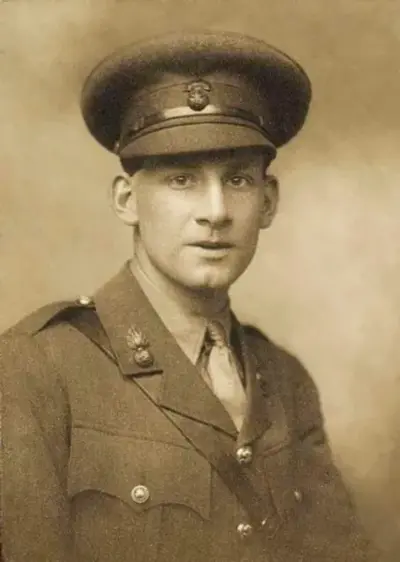
Siegfried Loraine Sassoon CBE MC was an English poet, writer, and soldier. Decorated for bravery on the Western Front, he became one of the leading poets of the First World War. His poetry both described the horrors of the trenches and satirised the patriotic pretensions of those who, in Sassoon's view, were responsible for a jingoism-fuelled war. Sassoon became a focal point for dissent within the armed forces when he made a lone protest against the continuation of the war in his "Soldier's Declaration" of 1917, culminating in his admission to a military psychiatric hospital; this resulted in his forming a friendship with Wilfred Owen, who was greatly influenced by him. Sassoon later won acclaim for his prose work, notably his three-volume fictionalised autobiography, collectively known as the "Sherston trilogy".
