John C. Calhoun Quotes
I will not undertake to offer an opinion on the capacity of Hindustan to produce cotton. The region is large, and the soil and climate various, the population great and wages low; but I must be permitted to doubt the success of the experiment of driving us out of the market, though backed and patronized by English capital and energy.
Calhoun, John C. The Works of John C. Calhoun. Edited by Richard K. Crallé, vol. 4, D. Appleton and Company, 1854.


5th Earl of Rosebery. With free trade, there are winners and losers. The advocates observe that overall, there is a great benefit to most countries engaging in free trade, but some sectors of the economy, and some areas and groups of people fare poorly.


In October 2025 (ahead of ongoing trade negotiations), the Ontario Provincial Government (Canadian) produced a video ad distributed in the US using a voice-over of the above quote from a 1987 Ronald Reagan Presidential Radio Address. The ad uses five complete sentences from the five-minute weekly address, but they are spliced together out of sequence. Also, while the ad implies Reagan was against tariffs, it omitted the context that he was using the radio address to announce new tariffs imposed on Japan by his administration but that they should be seen as an unavoidable exception to his basic belief in free trade as the key to prosperity. He said, “our commitment to free trade is also a commitment to fair trade.” President Trump accused the Ontario government of producing a fraudulent ad and of attempting to influence the US Supreme Court as it prepares to hear arguments about the legality of Trump’s tariffs. As a result, the Trump administration terminated trade negotiations with Canada.


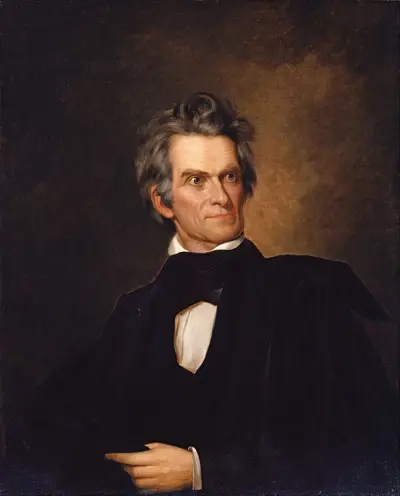
John Caldwell Calhoun was an American politician and political theorist from South Carolina who held many important positions including being the seventh vice president of the United States from 1825 to 1832, while adamantly defending slavery and protecting the interests of the white South when its residents were outnumbered by Northerners. He began his political career as a nationalist, modernizer, and proponent of a strong national government and protective tariffs. In the late 1820s, his views changed radically, and he became a leading proponent of states' rights, limited government, nullification, and opposition to high tariffs. He saw Northern acceptance of those policies as a condition of the South remaining in the Union. His beliefs and warnings heavily influenced the South's secession from the Union in 1860–1861.
