William Tecumseh Sherman Quotes
I will not accept if nominated, and will not serve if elected.
Lewis, Lloyd. Sherman: Fighting Prophet. Harcourt, Brace and Company, 1932.

He had served as VP with Teddy Roosevelt who was not going to run in 1908 and Fairbanks wanted the job. This statement was made because as the sitting VP he would easily be nominated for the same role and he didn’t want that. TR did not support him however and instead endorsed Taft who with TR’s support won the nomination and the General Election. When TR ran again in 1912 on the Bull Moose ticket, Fairbanks agreed to run as the VP candidate with Charles Evans Hughes and “pay” TR back as Hughes, a brilliant but pompous fellow was expected to win handily with TR’s ex VP—Fairbanks—running with him. However, Hughes and TR split the Republican vote, and Democrat Woodrow Wilson won the Presidency to the shock of Hughes and Fairbanks. They came in 3rd with TR outpolling them.


This is one of the great erroneous predictions of American political history. He was not nominated on the second ballot. Nor on the third; Lincoln was

After his presidency, Adams returned to Massachusetts where some of his neighbors approached him about running for Congress. Some were concerned that, having served in the highest office of the land, he might be degraded by becoming a congressman:. Adams was elected and served many years in Congress—the only American President to do so.

Later, Eisenhower changed his mind and ran for the Republican Presidential Nomination. Truman, who had always been a strong Eisenhower enthusiast, felt that Eisenhower had lied to him and was distrustful of the General ever after.


_0_PostageStamp_47x47.jpg "Chairman of the Joint Chiefs of Staff Navy Adm. Mike Mullen gives an interview to John Dickerson during the CBS news program Face the Nation in Washington, D.C., July 5, 2009. During the interview, Mullen discussed the wars in Iraq and Afghanistan, North Korea's recent missile tests and his recent visit to Russia. (DoD photo by Mass Communication Specialist 1st Class Chad J. McNeeley, U.S. Navy/Released)")


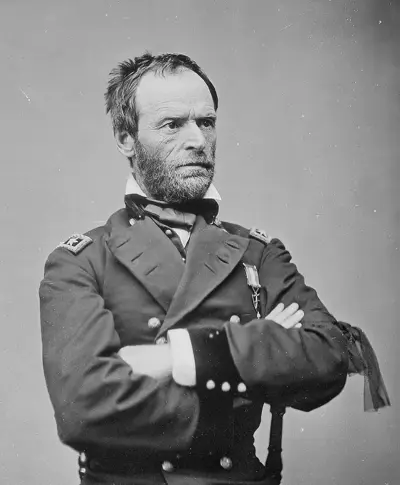
William Tecumseh Sherman was an American soldier, businessman, educator, and author. He served as a general in the Union Army during the American Civil War (1861–1865), receiving recognition for his command of military strategy as well as criticism for the harshness of the scorched earth policies he implemented in conducting total war against the Confederate States. British military theorist and historian B. H. Liddell Hart declared that Sherman was "the first modern general".
