Edmonia Lewis Quotes
I was practically driven to Rome in order to obtain the opportunities for art culture and to find a social atmosphere where I was not constantly reminded of my color. The land of liberty had no room for a colored sculptor.
"Seeking Equality Abroad." The New York Times, 29 Dec. 1878, p. 5.

Clay supported the relocation of freed slaves to Liberia through the American Colonization Society.


Reconstruction was the period in the South after the Civil War. The change that emancipation brought to the white South was traumatic, and there was a constant struggle between those who wanted the Blacks to be integrated into Southern Society—and those Southerners who wanted to create a society that would be as close to slavery as possible, So the Klu Klux Klan and other terrorist organizations formed and with lynching and other intimidation, much of the initial progress of Reconstruction was rolled back and did not get reinstated until the Civil Rights and Voting Rights Acts were passed in 1964.

Charleston was in the Southern part of the state where most people supported slavery. Douglas made an unequivocal pitch for the racist vote {600060} and forced Lincoln to take a stand. Like many politicians today, Lincoln decided to give the audience what they wanted to hear. It is not clear whether or not he ever believed this statement or was just pandering in a political campaign. He had never said this in the Northern part of the state of before. Lincoln’s views on race changed and matured over the years, culminating in the Emancipation Proclamation. Lincoln lost the Senate seat to Douglas.

His solution was not to change the prejudice or improve the opportunity for Blacks but to have complete separation of the races. See {625687}.


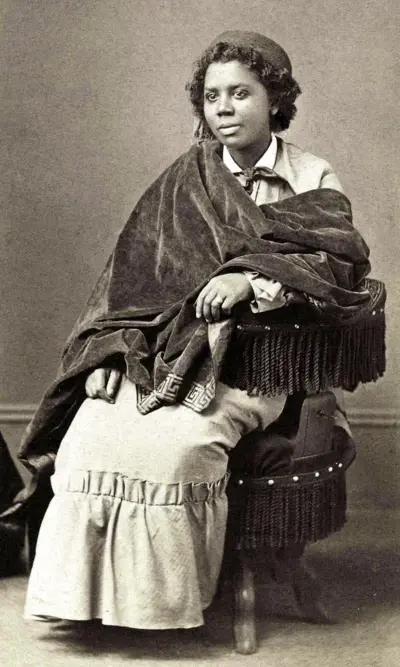
Mary Edmonia Lewis, "Wildfire", was an American sculptor, of mixed African American and Native American (Ojibwe) heritage. Born free in Upstate New York, she worked for most of her career in Rome, Italy. She was the first African-American sculptor to achieve national and then international prominence. She began to gain prominence in the United States during the Civil War; at the end of the 19th century, she remained the only Black woman artist who had participated in and been recognized to any extent by the American artistic mainstream. In 2002, the scholar Molefi Kete Asante named Edmonia Lewis on his list of 100 Greatest African Americans.
